

Article

Understanding the Role and Purpose of Data Centers: More Than Just IT Hype?


 By :
By : 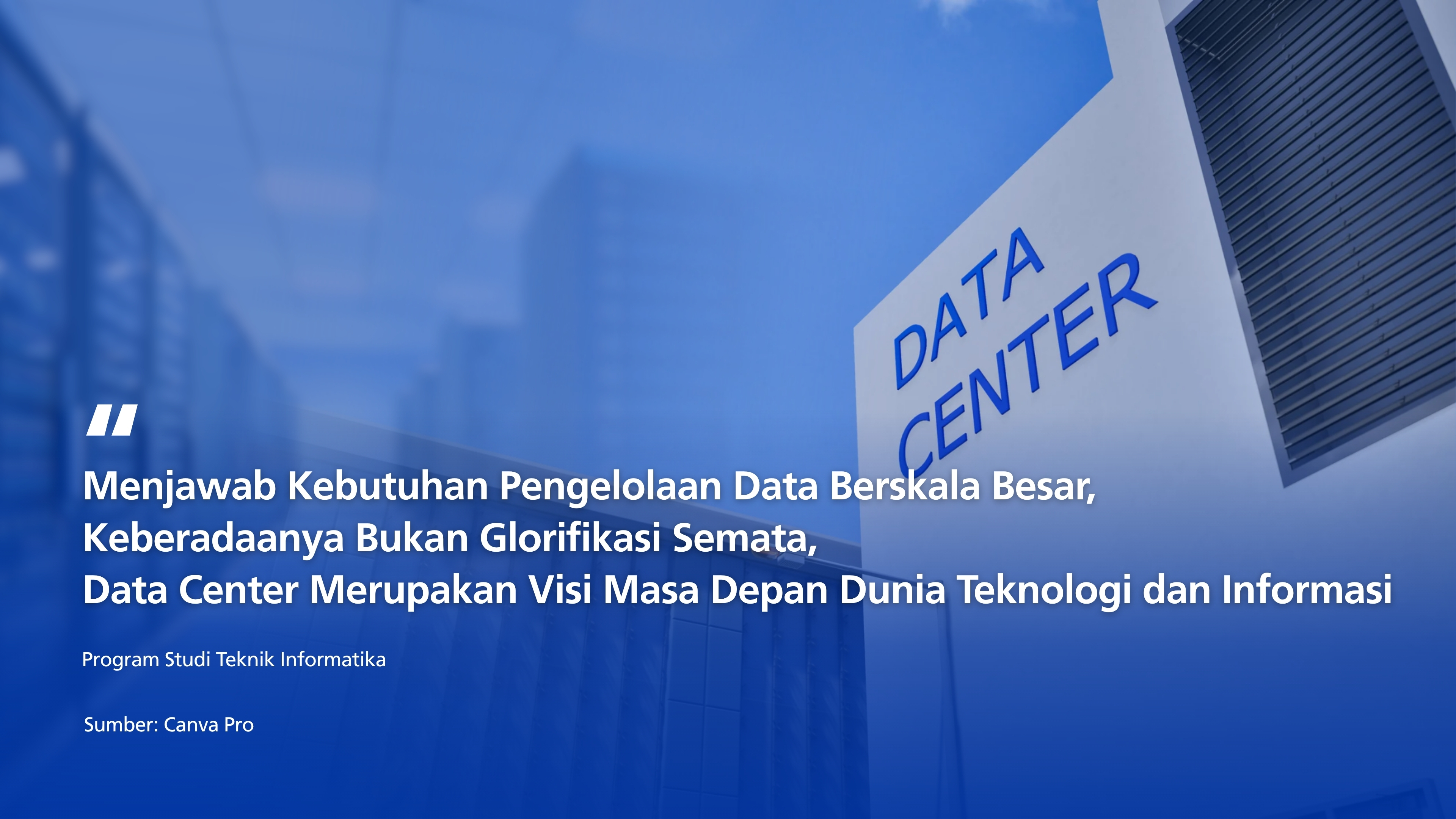
In today’s digital era, where data-driven thinking and the continuous development of Artificial Intelligence (AI) are becoming increasingly important, almost every activity we carry out is connected to and supported by one essential element: data. Data has become an integral part of modern life, from distributing information and supporting communication to serving as the foundation for developing smart devices and digital innovations.
As the volume of data continues to grow, data centers are receiving increasing attention from the technology and information industry. But what exactly is a data center, and is it really more than just another buzzword in the IT world? Let’s take a closer look, Kawan UNDIRA.
As the backbone of large-scale data management, data centers are no longer viewed merely as a symbol of technological advancement. Instead, they have become a strategic investment for companies across various industries. At their core, data centers are specialized facilities designed to store, manage, and process large volumes of data and operate computer systems at a scale that conventional computers and handheld devices simply cannot handle.
With the number of internet users reaching 6.12 billion as of April 2026, equivalent to approximately 73.8% of the world’s population, alongside the rapidly growing phenomenon of the AI bubble, it is hardly surprising that data center infrastructure has become a major focus for technology companies such as Amazon, Google, Telkom, Indosat, and various hosting and server providers.
A physical data center typically consists of dedicated spaces equipped with network infrastructure such as routers and switches, as well as internal and external security systems designed to prevent data breaches and mitigate threats such as zero-day attacks. It also houses servers responsible for data processing, power generators and backup systems such as Uninterruptible Power Supply (UPS) units to ensure a stable and uninterrupted power supply, and, perhaps most importantly, cooling systems.
Because data centers operate continuously, 24 hours a day, seven days a week, effective temperature management is essential to prevent servers from overheating and maintain optimal performance.
Although it may sound complicated, Kawan UNDIRA can actually build a small-scale data center as well, provided there is suitable hardware that can be configured as servers and an adequate temperature and air circulation system.
While developing a data center can be highly profitable for many companies, building or selecting one is certainly not as simple as installing servers and plugging them into a power outlet. Numerous variables need to be carefully considered to ensure that the investment is effective, reliable, and sustainable in the long term. Here are several important considerations:
-
Consider the geographical location. Choose a location with minimal exposure to natural disasters such as earthquakes, floods, and landslides. The local climate should also support cooling efficiency, while potential sources of electromagnetic interference should be taken into account. Access to a stable electricity supply is equally important.
-
Ensure reliable network connectivity. Ideally, a data center should be located close to an Internet Exchange Point (IXP) and connected to multiple network providers or carriers. This helps reduce latency while minimizing the risk of downtime caused by disruptions from a single provider.
-
Plan for future scalability. Data requirements are likely to continue growing. A well-designed data center should therefore allow its capacity to be expanded easily without requiring the entire facility to be rebuilt from scratch.
Looking at its many roles, from supporting everyday digital services and providing the infrastructure behind AI development to enabling even smaller businesses to access world-class digital infrastructure, it is clear that data centers are far more than just technological hype. They have become a genuine necessity in the digital era, while also presenting real challenges that require careful planning to ensure that technological development does not conflict with environmental considerations or the interests of local communities.
The Informatics Engineering Study Program at Universitas Dian Nusantara (UNDIRA) offers a Network Enterprise specialization specifically designed to equip students with the skills needed to design, build, secure, and manage network and server infrastructure, from small-scale environments to enterprise-level systems.
So, don’t just be a consumer of technology. It’s time to become part of the people who build and secure the infrastructure behind it.
Learn more about the Network Enterprise specialization in the Informatics Engineering Study Program at UNDIRA through undira.ac.id, and take your first step toward a career in networking and digital infrastructure.
Source of References:
Apa Itu Data Center? Pengertian, Fungsi, dan Jenis-Jenisnya [Diperbarui 2026]
Apa Itu Data Center Telkom? Fasilitas Penyimpanan Data Bisnis
Press Contact :
Biro Humas & Sekretariat Universitas Dian Nusantara
Facebook : www.facebook.com/undiraofficial
Instagram : www.instagram.com/undiraofficial
Twitter : www.twitter.com/undiraofficial
www.undira.ac.id
Other

Community Service of Lecturers and Students of ILKOM UNDIRA Building Digital Literacy of Street Children
Read more
The Euphoria of the Cryptocurrency Trend and Its Implications for Educational Interest Among the Youth
Read more.jpg)
Utilization of Environmentally Friendly Materials in Soil Reinforcement: Is It Feasible? Insights from UNDIRA Civil Engineering Research
Read more
Campus Tanjung Duren
Jln. Tanjung Duren Barat II No. 1
Grogol, Jakarta Barat. 11470
Campus Green Ville
JIn. Mangga XIV No. 3
Campus Kranggan
Jln. Raya Kranggan, No.6,
Jatiraden, Kec. Jatisampurna, Bekasi. 17432


