

Article

Translation and Reliance on AI: Is Human Intervention Still Necessary? Insights from an English Literature Lecturer


 By :
By : 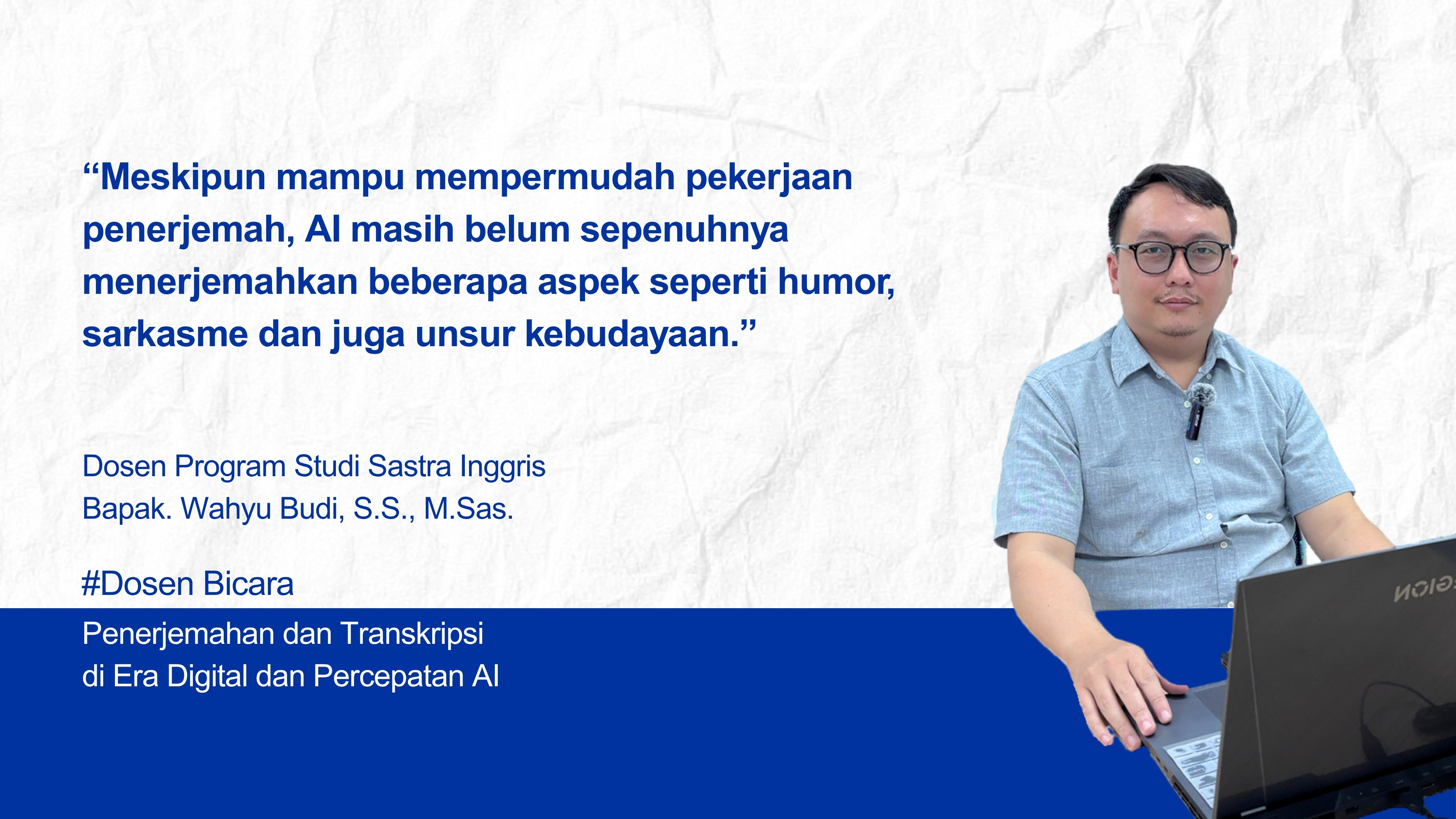
There is no denying that technological advancement has brought significant benefits to a wide range of academic disciplines and professional fields. Today, with increasingly powerful computing devices and integrated access to artificial intelligence (AI), tasks that once required hours—or even days—can now be completed in just minutes or seconds.
Translation is among the many professions that have been transformed by AI. What was once a time-intensive process can now be carried out more quickly and, in many cases, with remarkable accuracy through AI-powered translation tools.
Yet one important question remains, particularly among English translators: Has AI and automation truly transformed the translation industry to the point where human involvement is no longer necessary?
In an episode of Dosen Bicara by the English Literature Study Program at Universitas Dian Nusantara (UNDIRA), Wahyu Budi, S.S., M.Sas., a lecturer in the program, explained that the answer is not as straightforward as it may seem. According to him, the human touch remains an essential component of high-quality translation.
Mr. Wahyu highlighted that AI offers a variety of features that significantly streamline the translation process. One of its most valuable capabilities is speech-to-text technology, which automatically converts spoken language into written text. However, despite these advances, AI still struggles to accurately interpret forms of communication that rely heavily on humor, sarcasm, and cultural nuance.
"In translation, particularly in subtitling, there is a process known as time coding, which synchronizes translated text with a speaker's dialogue using automatically generated text from built-in translation tools. In my opinion, however, AI is still unable to fully translate humor. Beyond humor, it also has difficulty conveying sarcasm and cultural references. This is where human translators continue to serve as the primary quality assurance in the translation process, even when AI or other software is involved," Mr. Wahyu explained.
He further emphasized that AI has yet to fully comprehend elements such as intonation, emotional expression, and subtle linguistic nuances. These aspects require human judgment to ensure that every translated word not only conveys the intended meaning but also preserves its stylistic and emotional impact.
"A translator or subtitler must possess strong linguistic sensitivity as well as a deep understanding of culture and social context in order to produce translations that are not only accurate but also meaningful in terms of nuance and expression. Once we understand the cultural background and context, we must also ensure readability. For example, subtitles should not exceed 43 characters per line or more than three lines in a single subtitle," he added.
Ultimately, translation in today's world should no longer be viewed as a simple man versus machine debate. Instead, it is about how humans and AI can complement one another, each contributing their respective strengths rather than competing for superiority.
AI accelerates the translation process, while human translators ensure that the final result truly resonates with readers or audiences—not only in terms of accuracy, but also in meaning, tone, and linguistic authenticity.
The translators who will thrive in the future are neither those who reject technological innovation nor those who rely entirely on AI. Instead, they are professionals who understand how to leverage technology effectively while maintaining strong linguistic intuition, cultural awareness, and critical thinking.
The English Literature Study Program at Universitas Dian Nusantara (UNDIRA) provides an ideal environment for students who aspire to build those competencies. Beyond mastering linguistic theory, students are encouraged to think critically about how technology and AI can be applied responsibly and effectively in the professional world, including in the field of translation.
Learn from technology, make the most of it, but never stop sharpening your linguistic sensitivity and cultural understanding. In the end, it is the human touch that gives every piece of writing and every translation its true depth, authenticity, and life.
Source of References:
Dosen Bicara: Bapak Wahyu Budi, S.S., M.Sas - TikTok UNDIRAOfficial Part 1
Dosen Bicara: Bapak Wahyu Budi, S.S., M.Sas - TikTok UNDIRAOfficial Part 2
Press Contact :
Biro Humas & Sekretariat Universitas Dian Nusantara
Facebook : www.facebook.com/undiraofficial
Instagram : www.instagram.com/undiraofficial
Twitter : www.twitter.com/undiraofficial
www.undira.ac.id
Other
.jpg)
Beyond Mere Daily Usage: Discover the 6 Essential Skills for Mastering AI!
Read more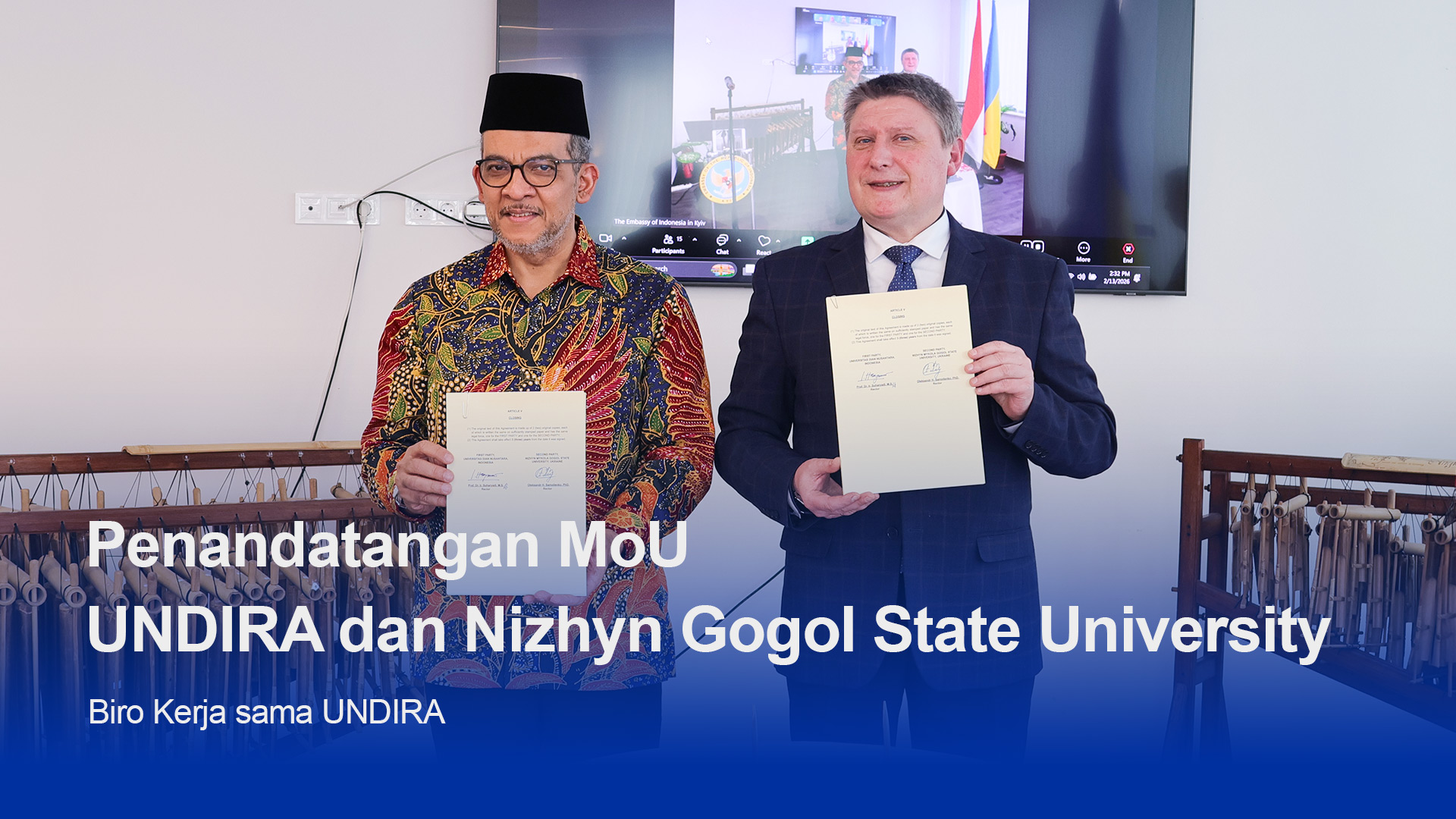
Strengthening International Level Academic Relations UNDIRA Explores Collaboration with Nizhyn Gogol State University
Read more.jpg)
The Rector of UNDIRA Inaugurates 1,049 New Students at the Opening of the New Semester for the 2024/2025 Academic Year.
Read more
Campus Tanjung Duren
Jln. Tanjung Duren Barat II No. 1
Grogol, Jakarta Barat. 11470
Campus Green Ville
JIn. Mangga XIV No. 3
Campus Kranggan
Jln. Raya Kranggan, No.6,
Jatiraden, Kec. Jatisampurna, Bekasi. 17432


