

Article

We Guard the Forest, the Forest Guards Us: Understanding Earth and Sky’s Frontline Protector


 By :
By : 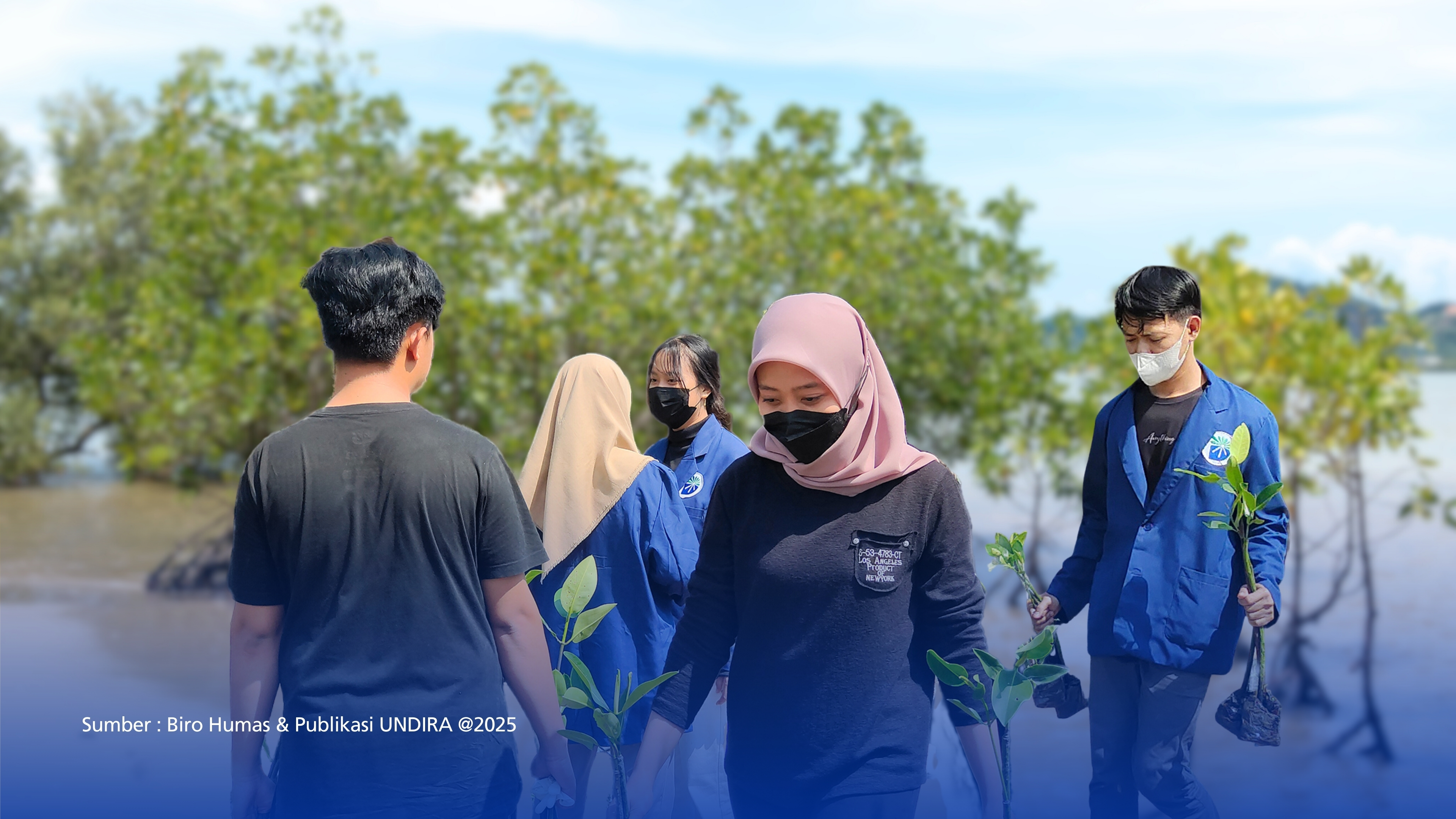
Recently, fellow UNDIRA students may have become familiar with the planning of monoculture agro-economic zones, such as the palm oil plantations in Papua and other regions. Furthermore, mining land expansion has become a central topic of discussion among the Indonesian public and global conservation communities. In short, due to excessive expansion, our Earth is not doing well.
Despite being a strategic step for economic growth, we must not forget the philosophy that "The forest is our mother"—what comes from the forest will eventually return to it.
Although forests are often treated as easily managed commodities, they are, in fact, sensitive assets that hold the key to the survival of all living beings. The forest is a silent yet vital frontline, constantly maintaining the ecosystem's balance for both wildlife and humans alike. Indeed, our primary protector is none other than the forest.
Beyond its role as a source of life and an ecological pillar, the forest is one of the world's largest "lungs." According to 2025 data from the Food and Agriculture Association (FAO) as cited by CNBC Indonesia, global forest areas now cover 32% of the world's total landmass.
Located on the equator, Indonesia possesses vast vegetation that supports immense biodiversity, earning its title as one of the world's primary "Lungs of the Earth." Indonesia is recorded as having the third-largest forest area globally, spanning 95,969 hectares consisting of tropical rainforests, peatlands, and mangroves. The largest portions of these forests are located in Kalimantan and Papua.
Regarding global distribution, forests contribute approximately 20-28% of the world's oxygen. This is made possible through photosynthesis—a process that not only powers the plants but also releases oxygen into the atmosphere. Forests are fundamentally capable of absorbing up to 2.6 billion tons of carbon dioxide as a raw material for this process.
Furthermore, through natural evaporation—which fellow UNDIRA students might recognize as the cool, misty air in mountainous regions—forests regulate local temperatures by releasing water vapor to stabilize the surrounding atmosphere.
While we have discussed how forests regulate air quality and temperature, another crucial aspect is their function as soil density regulators.
Fellow UNDIRA students surely understand that a natural forest, with its diverse and canopy-rich trees, is vastly different from a monoculture "forest" of oil palms. Although oil palms are trees, unlike true forests, they do not provide a sanctuary for wildlife such as birds or primates.
In terms of water absorption and soil fortification, true forests possess root systems that can not only absorb large quantities of water but also spread wide and deep. This differs from oil palm roots, which tend to grow in a single direction and remain shallow. These natural forest roots reinforce the soil structure, preventing floods and landslides, especially in sloped mountainous areas.
The time has come for us to care for our forests. Dian Nusantara University (UNDIRA), which instills a culture of vision, integrity, and professionalism beyond the classroom, offers a platform through its student organization, MAPALA (Nature Lovers Student Association). It provides opportunities for students to not only conserve nature collectively but also to educate others on the vital importance of the ecosystem itself.
Fellow UNDIRA students, amidst the various disasters that have struck our archipelago, let us realize that harmony and symbiosis with nature are the keys to our survival. By guarding the forest, the forest will, in turn, guard us. The forest is the mother of all living souls.
Source of References:
CNBC Indonesia - 10 Negara Dengan Hutan Terluas di Dunia, Indonesia Keberapa?
Eiger Tropical Adventure- Mengenal Hutan Konservasi di Indonesia, Jenis, Tujuan, dan Contohnya
Forest Watch Indonesia - Bersama-sama Menjaga Kesehatan “Paru-Paru” Dunia
(Danang Respati Wicaksono / Humas UNDIRA)
Press Contact :
Biro Humas & Sekretariat Universitas Dian Nusantara
Facebook : www.facebook.com/undiraofficial
Instagram : www.instagram.com/undiraofficial
Twitter : www.twitter.com/undiraofficial
www.undira.ac.id



Campus Tanjung Duren
Jln. Tanjung Duren Barat II No. 1
Grogol, Jakarta Barat. 11470
Campus Green Ville
JIn. Mangga XIV No. 3
Campus Kranggan
Jln. Raya Kranggan, No.6,
Jatiraden, Kec. Jatisampurna, Bekasi. 17432


