

Article

Reverse Engineering: A Perspective on Exploring Opportunities for Greater Accessibility in Research, Studies, and Innovation


 By :
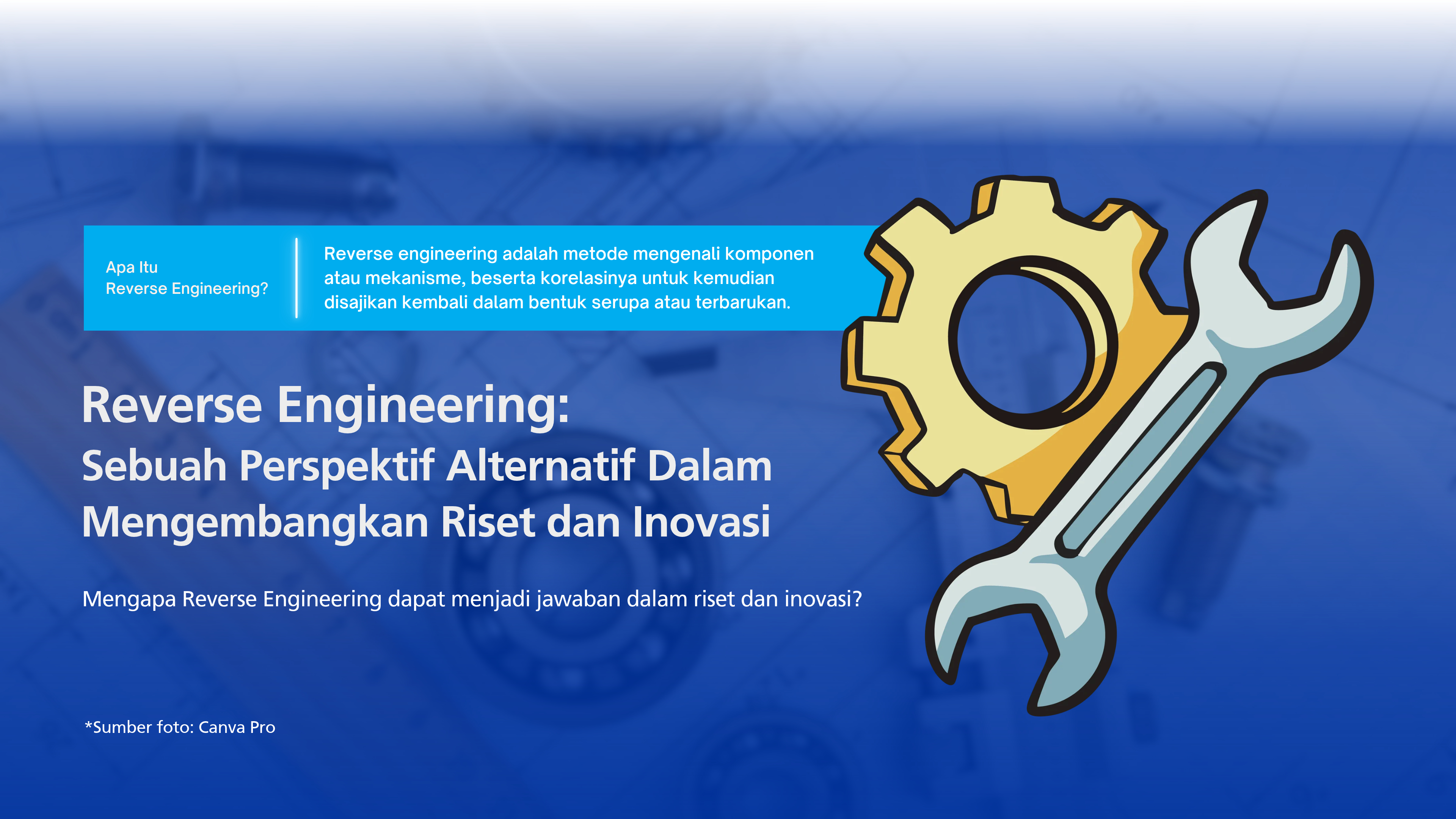
Imagine you are playing a video game, Kawan UNDIRA, and at some point, your curiosity gets the better of you. You decide to take the game apart and examine all its visual assets, databases, and even source code, without fully understanding how it works, the logic behind its design, or the original design documentation. From there, you could simply disassemble and replicate the game, or take things a step further by developing it with new features that were never there before. Well, congratulations! At this point, you have just engaged in reverse engineering.
In reverse engineering, researchers can apply various techniques depending on their respective fields. The process begins with observation, in which information about an object is gathered by examining and deconstructing its individual parts. This is followed by studying and understanding each component, before finally moving on to reconstruction, allowing the results to be compared with the original invention.
According to Chikofsky and Cross (1990), reverse engineering is a process of identifying the components and mechanisms behind a concept, along with the relationships between them, and then representing them in a similar or alternative form, potentially with improved performance.
Reverse engineering is not confined to a single field of study, Kawan UNDIRA. In the manufacturing sector, technicians may scan machine parts that are no longer in production and recreate their models using Computer-Aided Design (CAD). This allows them to study the original components and develop newer, more optimized versions. In the electronics industry, companies may examine competing products to compare their designs and production costs. Reverse engineering can also be applied in economics and business through product analysis and the study of market algorithms.
Chikofsky and Cross also outlined five key objectives of reverse engineering:
-
Managing Complexity: Reverse engineering helps people understand systems that are overly complicated or have extensive design structures. This aligns with one of its fundamental principles: breaking a system down into smaller components before examining how each part works and contributes to the whole.
-
Generating Different Perspectives: Chikofsky and Cross also highlighted how reverse engineering can offer new ways of looking at something. This becomes evident when we examine a product to uncover the underlying logic behind its creation, which can ultimately help us develop fresh perspectives and approaches.
-
Recovering Lost Information: Some works and inventions gradually disappear or become forgotten over time. Reverse engineering can help researchers restore these inventions by studying, analyzing, and reconstructing works for which physical evidence still exists. In other words, it can be used to uncover the design and operating principles of creations that were never properly documented or have since been forgotten.
-
Identifying Failures and Designing Better Products: When researchers examine older inventions piece by piece, they may discover hidden features or even technical flaws, such as software bugs. These findings can become valuable starting points for further development, improvement, and research.
-
Facilitating Reuse: Reverse engineering can help identify older components that remain useful and can be adapted or redeveloped as reusable components in new projects.
For the world of research and innovation, reverse engineering opens up possibilities that are often overlooked. By understanding and modifying what already exists, new ideas can emerge through different applications, improvements, or the combination of existing concepts in entirely new ways. Schumpeter (1934) viewed innovation as the creation of new combinations from existing elements, and reverse engineering helps us identify and understand those very elements.
Nevertheless, greater accessibility should never come at the expense of integrity. Responsible reverse engineering should focus on understanding and further developing existing works, rather than simply copying them. Perhaps the more meaningful question is no longer, "Is this truly something new?" but rather, "What have we learned, and what can we contribute?"
Perhaps this is where the maturity of research is truly put to the test: in our willingness to learn from the work of others, acknowledge their contributions honestly, and build upon them by contributing something meaningful that makes knowledge and scientific progress more accessible to everyone.
Sources of Reference:
T2Informatics - What is Reverse Engineering
Dr Josh Stroschein - The Cyber Yeti YouTube Channel - Intro to RE
Trust Component - Reverse Engineering: What It Is and How It Works
(Bapak Arie Pangesti Aji - Danang Respati Wicaksono / UNDIRA)
Press Contact :
Biro Humas & Sekretariat Universitas Dian Nusantara
Facebook : www.facebook.com/undiraofficial
Instagram : www.instagram.com/undiraofficial
Twitter : www.twitter.com/undiraofficial
www.undira.ac.id


Campus Tanjung Duren
Jln. Tanjung Duren Barat II No. 1
Grogol, Jakarta Barat. 11470
Campus Green Ville
JIn. Mangga XIV No. 3
Campus Kranggan
Jln. Raya Kranggan, No.6,
Jatiraden, Kec. Jatisampurna, Bekasi. 17432


