

Article

AI Overuse: A New Challenge for Generation Z? Here’s What You Need to Know


 By :
By : 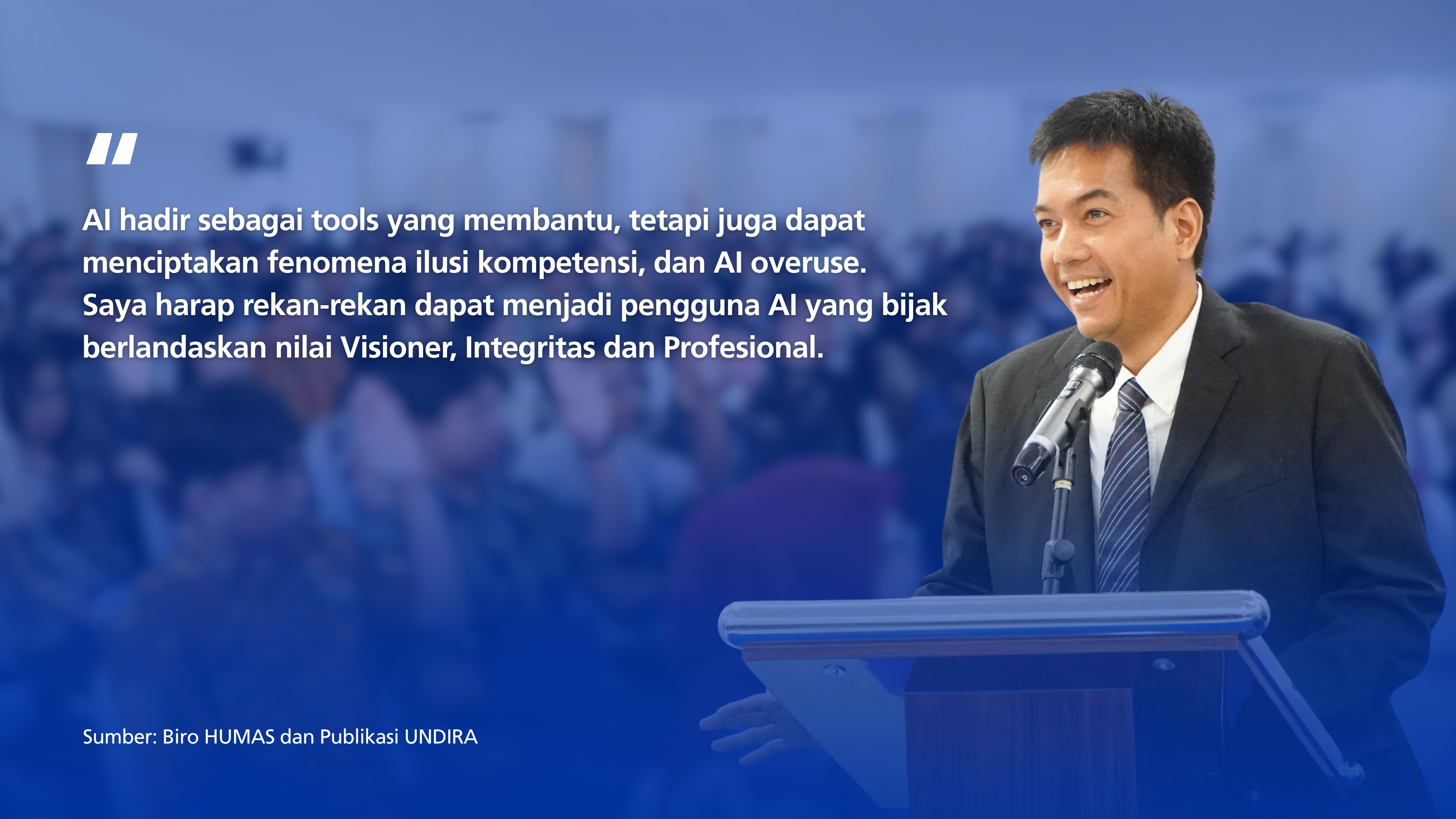
The rapid development of artificial intelligence (AI) has increasingly made it an almost indispensable part of human social life. AI is considered capable of performing tasks not only more quickly but also with greater efficiency, particularly given the biological limitations of human beings. Beyond its practical functions, AI is also increasingly seen as a “discussion partner” or conversational companion, filling spaces that were once only accessible through human-to-human interaction.
The accessibility and sense of connection created by AI appear to be particularly strong among Generation Z. According to a survey conducted by the Indonesian Internet Service Providers Association (APJII), as cited by RRI Indonesia, internet penetration in Indonesia reached 81.72% in 2026, while AI users accounted for 18.2%, with Generation Z making up the majority. This is hardly surprising, considering that Generation Z is widely recognized as a digital-native generation with relatively high workloads and mobility.
Although AI offers a range of benefits that can be highly useful, its use still needs to be monitored and approached thoughtfully. Kawan UNDIRA may have come across the phenomenon of AI overuse, or the excessive use of AI. In various studies, this phenomenon has also been associated with the concept of cognitive offloading, in which individuals tend to rely on external tools to help manage and process information.
Excessive reliance on AI may gradually diminish an individual's ability to think critically and independently. Furthermore, overdependence on AI can also increase the potential for errors and misinformation, which, in certain circumstances, may lead to serious consequences.
Several psychological studies featured in a publication by the American Psychological Association on September 1, 2026, have discussed a phenomenon referred to as AI psychosis. While the term is not recognized as a formal clinical diagnosis, it has been associated with delusional behaviors that may emerge from excessive interactions with AI, particularly when individuals begin to place unquestioning trust in the advice it provides.
Recognizing the potential impact of AI overuse, Chairman of the Dian Asra Foundation, Mr. Sagoro Dharmawan, S.E., emphasized that as an educated generation guided by academic principles, Generation Z must learn to balance its use of AI with wisdom and responsibility.
In his address at the Opening of the Even Semester of the 2026–2027 Academic Year at the Kranggan and Tanjung Duren Campuses of Universitas Dian Nusantara (UNDIRA), he highlighted the importance of Generation Z gradually shifting its mindset from being solely target-oriented toward becoming more process-oriented. He noted that such a shift could help reduce the tendency toward instant gratification while also encouraging a more balanced approach to AI use.
“The acceleration of technology, particularly in the field of AI, as we understand it today, has opened countless new windows of opportunity for humanity. Nevertheless, its presence also brings contrasting perspectives. On one hand, AI creates an enormous number of opportunities, but on the other, it presents a number of challenges, one of which is AI overuse, or excessive dependence on AI. In the past, we might have gone home carrying questions with us. Today, we tend to feel satisfied with nothing more than a full stop at the end of an answer.
“Excessive AI use has also given rise to what I would describe as an illusion of competence, a condition in which AI-generated information and work are placed on such a high pedestal that they are assumed to represent an individual's competence, even though that person may not necessarily possess the actual knowledge or ability to take responsibility for the work produced by AI.”
“Therefore, I would like to remind everyone that targets and grades alone should not be regarded as the ultimate goals. As human beings, we must continue to pursue knowledge throughout our lives. Remember, AI does not possess logic, intuition, or empathy in the way humans do. Everything it presents ultimately depends on us, as human beings, to refine it and give it meaning, direction, and moral responsibility, qualities that can never be fully replaced by machines,” said Mr. Sagoro Dharmawan.
The phenomena of AI overuse, cognitive offloading, and AI psychosis, together with the message conveyed by Mr. Sagoro Dharmawan, serve as another reminder that amid the accelerating adoption of AI, human intuition and empathy must remain at the heart of the creative process. The goal is not merely to produce work that looks impressive, but to create something that remains genuinely meaningful and human-centered.
Human progress may sometimes appear slower than the capabilities of machines. Yet human wisdom, intuition, and the depth of the human spirit remain qualities that technology cannot replace.
Sources of References:
Understanding “AI psychosis” - American Psychological Association
Info Keliru dari AI Nyaris Picu AS Serang Kapal China di Timur Tengah - detiknews.
Survei APJII 2026: Gen Z Pengguna AI Paling Aktif - RRI News
(Danang Respati Wicaksono / Humas UNDIRA)
Press Contact :
Biro Humas & Sekretariat Universitas Dian Nusantara
Facebook : www.facebook.com/undiraofficial
Instagram : www.instagram.com/undiraofficial
Twitter : www.twitter.com/undiraofficial
www.undira.ac.id
Other

Table Manner Practice Course: Preparing Students for the Professional World
Read more
Strengthening Studies and Innovation, UNDIRA Civil Engineering Program Signs MoU with Industrial Links International PTE Ltd.
Read more
Behind His Passing Lies an Enduring Legacy: Commemorating the Death of Jesus Christ
Read more
Campus Tanjung Duren
Jln. Tanjung Duren Barat II No. 1
Grogol, Jakarta Barat. 11470
Campus Green Ville
JIn. Mangga XIV No. 3
Campus Kranggan
Jln. Raya Kranggan, No.6,
Jatiraden, Kec. Jatisampurna, Bekasi. 17432


