

Research and Innovation

Addressing Inter-Island Logistics Challenges: How Effective Is Ferry Ro-Ro as an Alternative to the Sea Toll Program?


 By :
By : 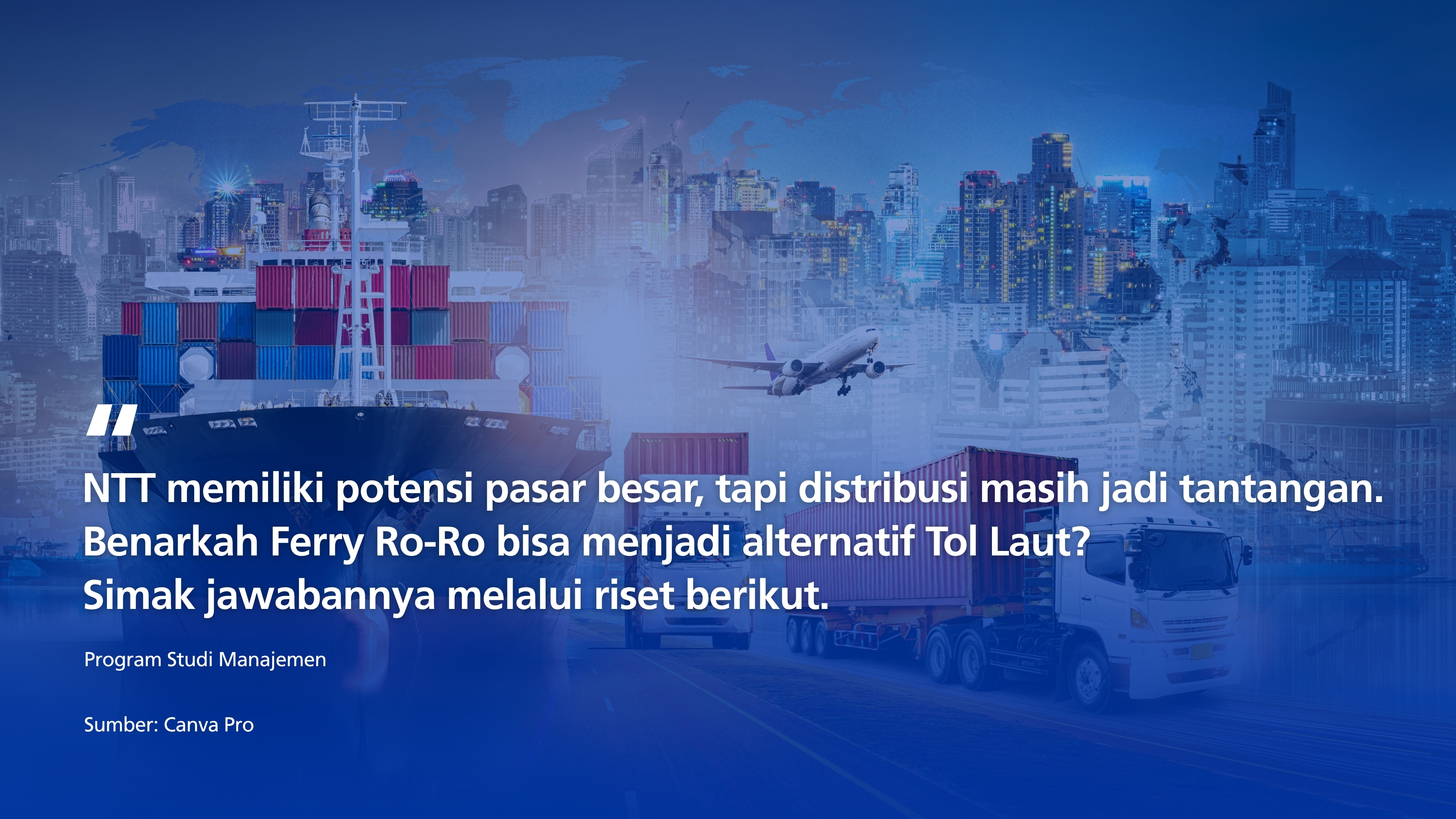
Indonesia’s economic ecosystem is entering a new phase. As export and import networks become increasingly accessible to businesses of all sizes, economic growth is no longer concentrated solely in major regions such as Java and Sumatra.
East Nusa Tenggara (NTT), in particular, holds considerable potential to support the national economy through fisheries, tourism, mining, and livestock. However, inflation-driven increases in the prices of essential goods, combined with intense competition for market share in Indonesia’s densely populated regions, have widened the disparity faced by local products.
Against this backdrop, Nur Endah Retno Wuryandari, S.Sos., M.M., a lecturer in the Management Study Program at Universitas Dian Nusantara (UNDIRA), together with academic representatives from the Indonesian Land Transportation Polytechnic and the Indonesian Maritime Science Polytechnic, conducted an analysis and comparative study to assess the effectiveness of Ferry Ro-Ro as an alternative to the government’s Sea Toll Program for local businesses. The study also evaluated the program that has been implemented by the local government.
The analysis covered several dimensions, including logistics processes, logistics financing, supply and demand dynamics across the supply chain, and a comparative assessment of transportation costs between the Sea Toll Program and Ferry Ro-Ro services. The study was expected to highlight and promote the potential of the Jangkar–Kupang route as a trade corridor connecting East Java and NTT, while also encouraging stronger collaboration with local governments to ensure that Sea Toll cargo distribution can be better monitored and delivered effectively to end users.
Methodologically, the study employed a mixed-method approach, combining qualitative and quantitative methods through focus group discussions (FGDs). Data were collected directly in Kupang, NTT, covering the hinterland areas of Timor Island over a period of approximately two years, from 2022 to 2024.
The findings revealed that NTT’s supply conditions vary significantly across commodities. Products such as red chili, bird’s eye chili, shallots, beef, chicken, onions, and corn showed surpluses and therefore have the potential to serve as return cargo. Meanwhile, commodities such as rice, soybeans, palm oil, sugar, flour, and eggs continue to experience supply deficits.

Ultimately, the research demonstrates that market penetration depends on more than established business networks alone. Other factors, including return-cargo mechanisms, local communities’ adaptation in balancing consumption patterns with available local resources, and the selection of optimal intermodal transportation routes, also play an important role in expanding the reach of local products into other markets.
Trade-route simulations indicate the potential to increase the Sea Toll cargo market share from approximately 19% to 32%. Shipping frequency could also potentially increase to two to three trips per month, compared with container-based Sea Toll services that generally operate around once a month. With point-to-point distribution, the number of transshipment stages can be reduced, potentially lowering logistics costs while improving access to hinterland areas.
However, the study also emphasizes that Ferry Ro-Ro should not be viewed as an absolute replacement for container vessels. Its implementation still faces several challenges, including limited reefer plug availability, adjustments to loading and unloading procedures, and the need for regulatory harmonization and stronger interagency coordination. For this reason, the development of an integrated logistics center, the strengthening of MSMEs as resellers in hinterland areas, and closer monitoring of distribution all the way to end users are essential. The study further indicates that market segmentation by geographic area could create opportunities for Sea Toll cargo penetration of approximately 58–77% within targeted areas.
Ferry Ro-Ro offers a more frequent, point-to-point transportation alternative with the potential to expand the reach of the Sea Toll Program while creating a stronger two-way flow of trade between East Java and NTT. The findings presented in the paper, published in the journal Evergreen, demonstrate how academic innovation can be translated into practical strategies for governments, businesses, and communities.

The research, indexed in Scopus Q3 and also included in the Kyushu University Institutional Repository, as reflected in SCImago’s indexing and journal mapping, represents a commitment from the academic community to developing research-based solutions that can contribute to economic and business prosperity through more efficient, inclusive, and sustainable logistics strategies.
By bringing together data, transportation innovation, public policy, and the needs of businesses, research of this kind can provide a shared foundation for strengthening inter-island connectivity—not merely by connecting regions, but by creating more equitable economic opportunities. At the same time, it reinforces the importance of closer collaboration between academia and the Business and Industrial Sectors (DUDI), ensuring that research findings can be translated into tangible applications in business practices and industrial policymaking, ultimately supporting a more competitive and prosperous Indonesian economy.
Source of Reference:
Press Contact :
Biro Humas & Sekretariat Universitas Dian Nusantara
Facebook : www.facebook.com/undiraofficial
Instagram : www.instagram.com/undiraofficial
Twitter : www.twitter.com/undiraofficial
www.undira.ac.id
Other

2nd Graduation alongside 5th Anniversary: UNDIRA to graduate Off 660 Graduates, Ready to Face Global Challenges
Read more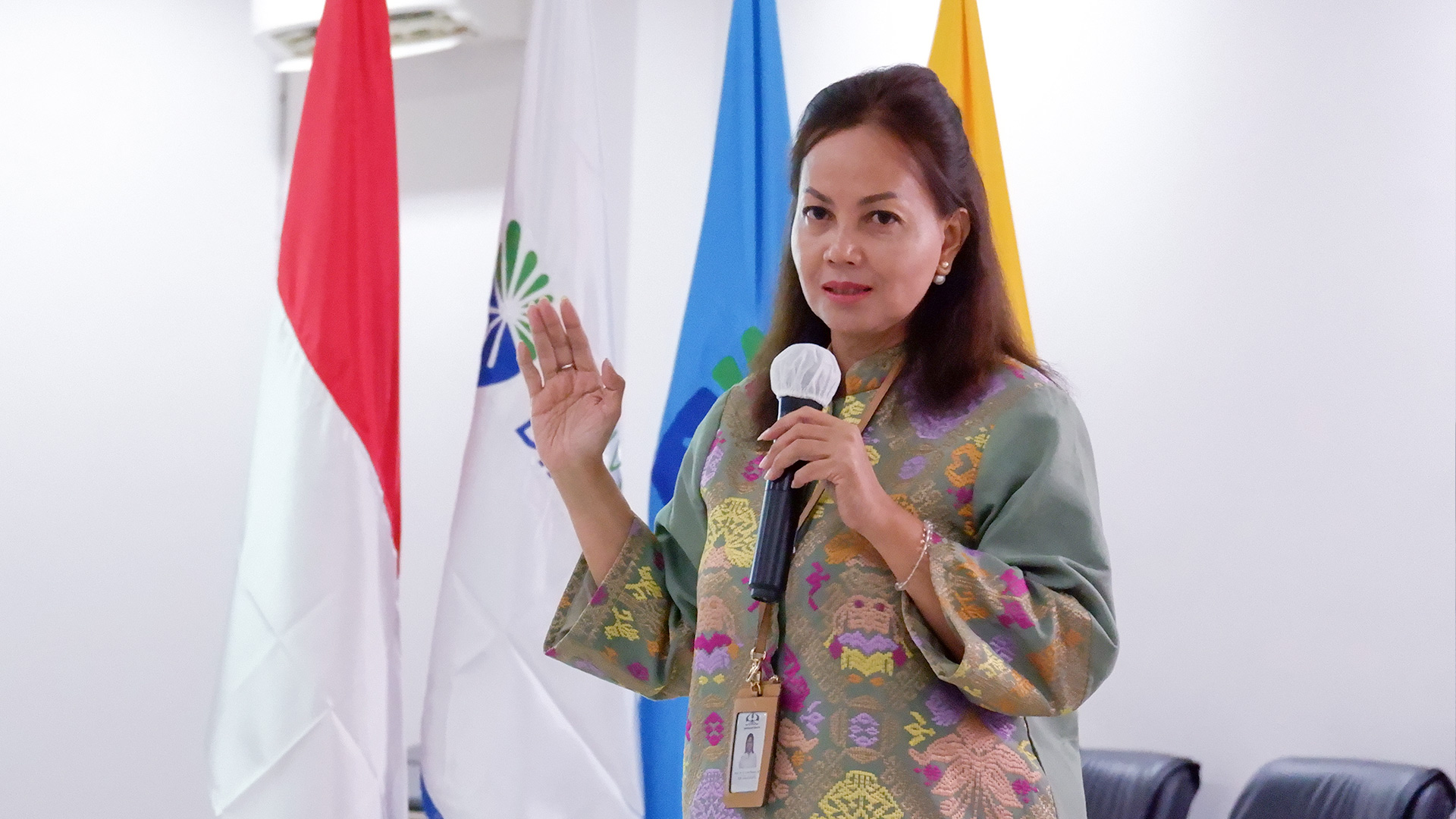
Emphasizing the Spirit of Research and Innovation of UNDIRA Lecturers: LRPM Holds DIKTI Grant Coaching Clinic 2025
Read more
Pillars of Economic Growth Through Time: The History and Role of Indonesia’s Capital Market – Commemorating Indonesia Capital Market Day
Read more
Campus Tanjung Duren
Jln. Tanjung Duren Barat II No. 1
Grogol, Jakarta Barat. 11470
Campus Green Ville
JIn. Mangga XIV No. 3
Campus Kranggan
Jln. Raya Kranggan, No.6,
Jatiraden, Kec. Jatisampurna, Bekasi. 17432


