

Research and Innovation

Cooling Drinks Made Simple: UNDIRA Mechanical Engineering Student and Lecturer Develop Portable Cooler Using Heat Sink and Peltier Effect


 By :
By : 
Practicality and portability have become increasingly important priorities across various industries, particularly in the development of everyday appliances. At the same time, rising mobility demands, along with the growing emphasis on reducing carbon emissions and improving energy efficiency, have encouraged manufacturers and researchers alike to rethink how modern devices are designed.
Against this backdrop, and as many parts of the world continue to experience prolonged dry seasons and rising temperatures, efficient cooling systems have become increasingly essential, especially for preserving food and beverages. Conventional cooling appliances such as refrigerators and air conditioners (ACs) offer excellent thermal performance. However, they are generally bulky, heavy, and require relatively high power consumption, particularly during startup.
Recognizing these challenges, Mechanical Engineering student Muhammad Adinda Hadinur, under the supervision of Mechanical Engineering lecturer Ir. Komarudin, M.T., developed a portable beverage cooling system. Their research has been published in the Greenation International Journal of Engineering Science (GIJES), December 2025–February 2026 edition.
Designed as a prototype measuring 20 × 30 × 30 cm, the portable cooling unit offers a compact and lightweight alternative to conventional refrigeration systems. Unlike traditional coolers, the device operates without a compressor or refrigerant, making it more portable while reducing system complexity.
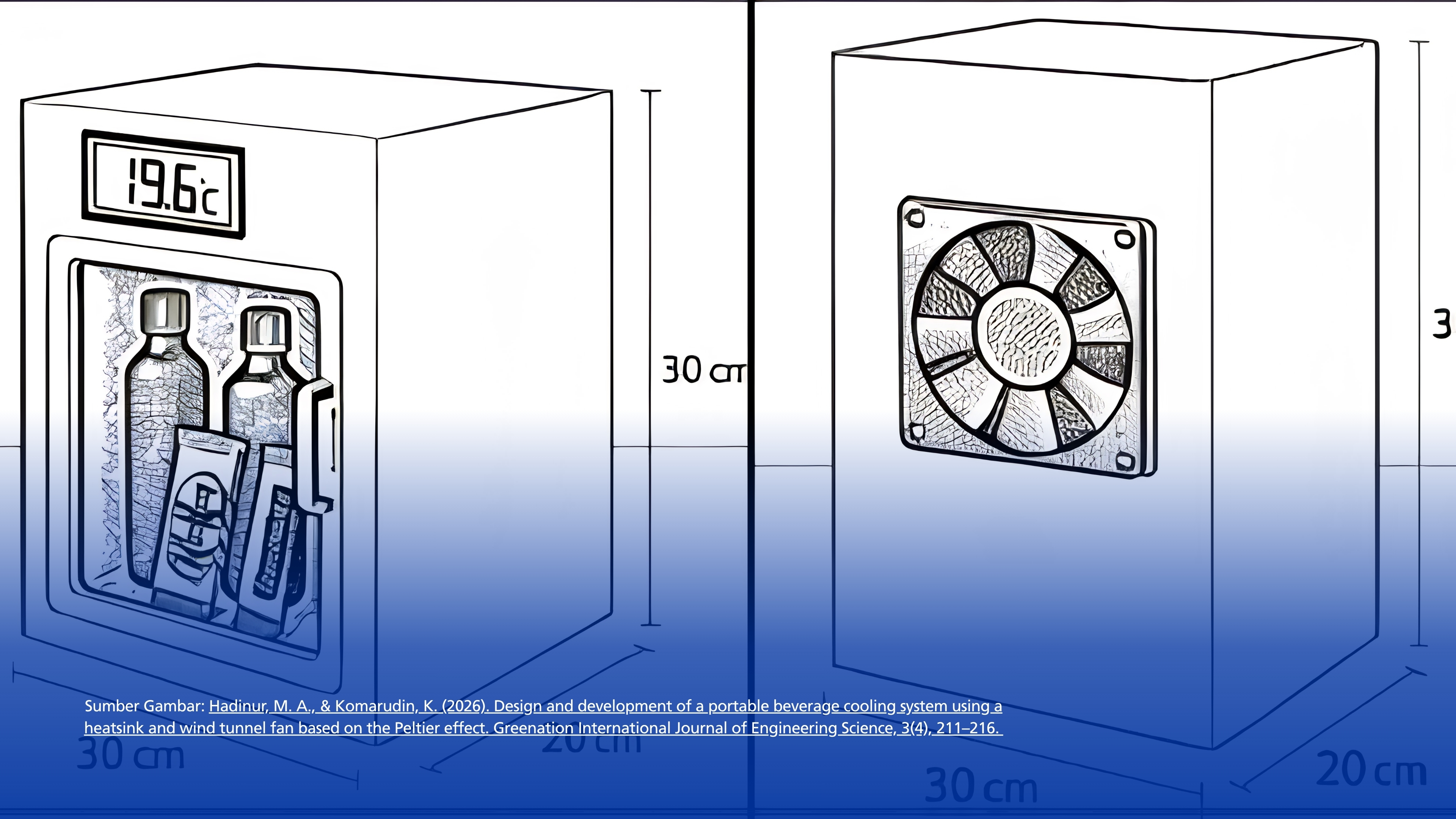
According to the study, the cooler is based on the Peltier effect, a thermoelectric phenomenon in which heat is transferred when direct current (DC) flows through the junction of two dissimilar semiconductor materials. As electricity passes through the module, one side absorbs heat while the opposite side simultaneously releases it, creating a cooling effect inside the insulated chamber.
Although the concept is highly promising, previous studies, including those by Rowe (2018), have highlighted one of the technology's primary limitations: excessive heat accumulation on the hot side of the Peltier module. Without proper heat dissipation, this buildup can significantly reduce cooling efficiency and slow the overall cooling process.
To address this challenge, Muhammad Adinda Hadinur and Ir. Komarudin incorporated an improved heat management system by integrating a heat sink with a wind tunnel fan. The principle is straightforward. The heat sink absorbs and distributes thermal energy from the Peltier module over a larger surface area, while the wind tunnel fan continuously removes the accumulated heat, allowing the cooling module to operate more efficiently.
From an engineering perspective, the prototype consists of one internal cooling fan, one external exhaust fan, and a TEC1-12706 Peltier module mounted at the rear of the cooling chamber. The system is powered by a single power supply unit requiring only 60–70 watts of electrical power, making it relatively energy-efficient. To help maintain a consistently low internal temperature, the interior of the cooling box is lined with aluminum sheets that serve as thermal insulation. The prototype is also equipped with a K-Type digital thermocouple to ensure accurate monitoring of the chamber's internal temperature.
Testing demonstrated encouraging results. Although still in the prototype stage, the portable cooling system successfully reduced the temperature of stored beverages to an average range of 9°C to 12°C within approximately 30 minutes, while maintaining relatively low power consumption.
Overall, this innovation represents a meaningful step toward developing practical, energy-efficient cooling solutions for small-scale and portable applications. More importantly, it demonstrates how applied research conducted by the academic community, particularly students and lecturers from the Mechanical Engineering Study Program at Universitas Dian Nusantara (UNDIRA), can contribute tangible solutions to modern challenges by improving energy efficiency while meeting the growing mobility needs of today's society through sustainable and application-oriented innovation.
Source of Reference:
Press Contact :
Biro Humas & Sekretariat Universitas Dian Nusantara
Facebook : www.facebook.com/undiraofficial
Instagram : www.instagram.com/undiraofficial
Twitter : www.twitter.com/undiraofficial
www.undira.ac.id
Other
Reviewing Achievements and Evaluating Curriculum to Provide the Best Education, UNDIRA Holds Faculty Coordination Meeting for Academic Year 2025/2026
Read more
Eid Fitr: A Moment to Celebrate Triumph Through Togetherness for Nurturing Well-being of All
Read more.jpg)
Translation: More Than Just Using AI, But Also Adjusting Meaning and Semantics
Read more
Campus Tanjung Duren
Jln. Tanjung Duren Barat II No. 1
Grogol, Jakarta Barat. 11470
Campus Green Ville
JIn. Mangga XIV No. 3
Campus Kranggan
Jln. Raya Kranggan, No.6,
Jatiraden, Kec. Jatisampurna, Bekasi. 17432


