

Article

Understanding Crab Mentality and Its Impact on Academic and Organizational Environments


 By :
By : 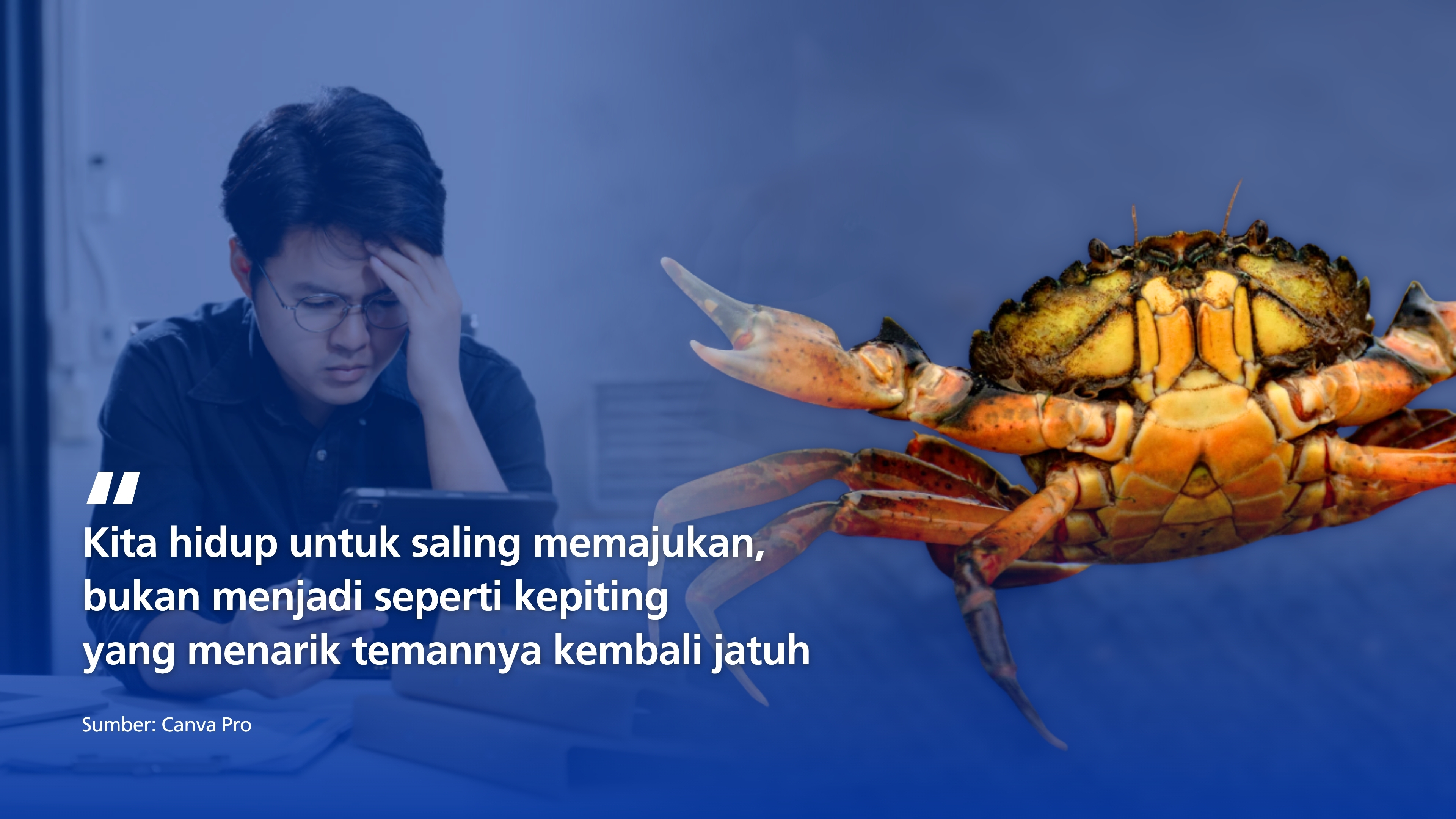
Imagine this, fellow UNDIRA students: you keep several pet crabs inside an open bucket. When one crab starts climbing upward in an attempt to escape, the other crabs will most likely pull it back down before it can get out. This phenomenon is commonly known as crab mentality.
So, what exactly is crab mentality? In psychology, crab mentality, also known as pull down syndrome, refers to a mindset or behavior in which individuals attempt to hinder, belittle, or even bring others down when they appear to be becoming more successful or gaining recognition. Interestingly, many experts believe that crab mentality does not always stem from malicious intent, but rather from paranoia and insecurity.
According to the Social Comparison Theory introduced by Leon Festinger in 1954, crab mentality can emerge from threats to self esteem or from comparing oneself to others. Instead of encouraging self reflection, these comparisons may motivate individuals to pull others down in order to protect their own ego.
Another factor that can trigger crab mentality is zero sum thinking, which is the belief that one person’s success automatically leads to another person’s failure or elimination. This mindset can create excessively competitive and even destructive behavior while also discouraging collaboration and collective progress.
In organizational environments, crab mentality can foster unhealthy competition and destructive ambition between divisions or individuals. Over time, this can damage teamwork structures and create the perception that every positive achievement is a threat, ultimately slowing organizational growth.
Within academic settings, crab mentality often takes an even more unfortunate form because its greatest victim is the spirit of learning itself. Students who actively ask questions may be labeled as “show offs.” High achieving students may become socially isolated. Young researchers with fresh ideas may be ignored or even have their work claimed by seniors. As a result, academic cultures that should celebrate curiosity and innovation instead become dimmed before innovation even has the chance to flourish.
Overcoming crab mentality is not simply about being kind. It requires intentional control and awareness at both the individual and institutional levels.
Since crab mentality is often rooted in paranoia and insecurity, the first step in breaking the cycle is encouraging openness instead of exclusivity, both in treatment and recognition. In addition, fostering a genuine culture of solidarity, one that is not based on exploiting others, can help build organizational ecosystems that are less vulnerable to prejudice and negativity.
In the fields of innovation, education, and academia, it is also important to normalize the understanding that not every achievement made by others is a competition that must be matched or surpassed.
Furthermore, people should learn to communicate with transparency and fairness in order to stop normalizing crab mentality. Simple statements such as “I think they truly worked hard for that” or “That idea sounds interesting, let us hear it first” can significantly change the direction of a conversation.
Crabs in a bucket do not realize that they are pulling one another deeper into decline. They act based on instinct rather than awareness. Humans are different.
Human beings possess the ability to recognize these patterns and choose not to participate in them. We have the capacity to build environments in workplaces, campuses, and organizations where someone else’s progress is celebrated rather than perceived as a threat. In such environments, the bucket itself becomes irrelevant because no one feels the need to pull others down.
Universitas Dian Nusantara consistently creates democratic and open spaces for creativity and expression for all UNDIRA students. Guided by the values of Visionary thinking, Integrity, and Professionalism, UNDIRA is committed to nurturing a responsible generation that values collaboration, sportsmanship, and character development because truly successful individuals are those who uplift one another instead of bringing others down.
So the question is simple: do you want to be the crab that pulls others down, or the hand that helps push them upward?
Source of References:
Crab Mentality, Sikap Orang Lain yang Menghambat Kesuksesanmu - Alodokter
Crab Mentality: Arti, Dampak, Faktor dan Cara Mengatasinya
Press Contact :
Biro Humas & Sekretariat Universitas Dian Nusantara
Facebook : www.facebook.com/undiraofficial
Instagram : www.instagram.com/undiraofficial
Twitter : www.twitter.com/undiraofficial
www.undira.ac.id
Other

Emphasizing the Spirit of Research and Innovation of UNDIRA Lecturers: LRPM Holds DIKTI Grant Coaching Clinic 2025
Read more
AI Advances Inclusivity: UNDIRA Informatics Engineering Lecturer Collaborates Across Universities to Develop ColorMate
Read more
Opinion and Bias: Understanding Logical Fallacies alongside the Importance of Critical Thinking
Read more
Campus Tanjung Duren
Jln. Tanjung Duren Barat II No. 1
Grogol, Jakarta Barat. 11470
Campus Green Ville
JIn. Mangga XIV No. 3
Campus Kranggan
Jln. Raya Kranggan, No.6,
Jatiraden, Kec. Jatisampurna, Bekasi. 17432


