

Article

Elevating AI Comprehension: Understanding Agentic AI and Its Advantages Over Generative AI


 By :
By : .jpg)
Artificial Intelligence (AI) has emerged as a prominent subject of academic and public discourse, propelled by the increasing accessibility of technology and automation. Today, AI applications are readily accessible, seamlessly integrated even into handheld mobile devices.
However, beyond its everyday applications and functionalities, a common misconception persists that AI is a monolithic entity. In reality, there are distinct types of AI infrastructures, each possessing unique operational parameters and capabilities, which are Agentic AI and Generative AI.
According to a faculty member from the Informatics Engineering Department at Universitas Dian Nusantara (UNDIRA), the operational framework of Generative AI is primarily predicated on synthesizing new data from existing datasets in response to user prompts. One prominent mechanism facilitating this is Generative Adversarial Networks (GANs). In instances of output discrepancies, users must iteratively refine their prompts to allow the system to correct the generated results.
Typically, Generative AI is employed to facilitate fundamental daily tasks, such as content creation, text summarization, and the compilation of educational materials based on predefined templates. Nevertheless, its inherent reliance on explicit prompts and pre-existing training data restricts its capacity to generate true novelty or autonomously resolve complex problems.
In response to these limitations, Agentic AI has been developed as a paradigm shift toward truly autonomous AI models. Transcending the mere execution of instructions and content generation, Agentic AI possesses the capability to establish and operate its own structured ecosystem with minimal human intervention. As elucidated by publications from IBM Think and Forbes, Agentic AI constitutes a self-regulating system capable of coordinating with other AI agents, thereby cultivating a highly independent operational ecosystem.
Fundamentally, Agentic AI integrates Large Language Models (LLMs), Natural Language Processing (NLP), and Machine Learning modules. Furthermore, it exhibits the capacity to orchestrate various subordinate AI modules, termed AI agents, to enhance output accuracy and facilitate divergent, out-of-the-box reasoning.
The operational architecture of Agentic AI encompasses four primary cognitive phases. The first phase is perceiving, which involves acquiring and analyzing data from its surrounding environment. This is followed by reasoning, where the system logically processes and evaluates the assimilated data. The third phase is acting, in which tasks are executed based on formulated plans and logical deductions. Finally, the learning phase allows the system to iteratively adapt by analyzing past failures and constraints encountered during previous task executions.
Consequently, Agentic AI functions far beyond superficial content generation, approaching the proficiency of a professional human assistant at a managerial level. Currently, the UNDIRA academic community can observe the implementation of Agentic AI across various advanced technologies. These include autonomous vehicles, data and administrative service automation utilizing algorithms such as K-means clustering, robotics, urban planning via intelligent surveillance systems, and sophisticated trading information systems.
The paradigm shift from Generative AI to Agentic AI signifies that the evolution of artificial intelligence is no longer confined to the capacity to create, but has advanced toward the capacity to act autonomously. While Generative AI serves as a reactive creative partner dependent on prompts, Agentic AI transcends this by introducing dimensions of systemic autonomy, strategic planning, and structured execution.
For fellow members of the UNDIRA community who are interested in deepening their comprehension of AI development mechanisms, Data Science, and Information Systems, the Informatics Engineering Study Program presents an optimal academic pathway. The program is supported by state-of-the-art facilities, including Computer Laboratories equipped with the latest software, and is led by professional faculty members dedicated to equipping students with specialized expertise in Network Engineering or Systems Engineering.
AI agentik vs. AI generatif - IBM Official Website
Apa yang dimaksud dengan AI agentic? - Google Official Website
Generative AI vs. Agentic AI: What Is the Difference? - Coursea
(Danang Respati Wicaksono / Humas UNDIRA)
Press Contact :
Biro Humas & Sekretariat Universitas Dian Nusantara
Facebook : www.facebook.com/undiraofficial
Instagram : www.instagram.com/undiraofficial
Twitter : www.twitter.com/undiraofficial
www.undira.ac.id
Other
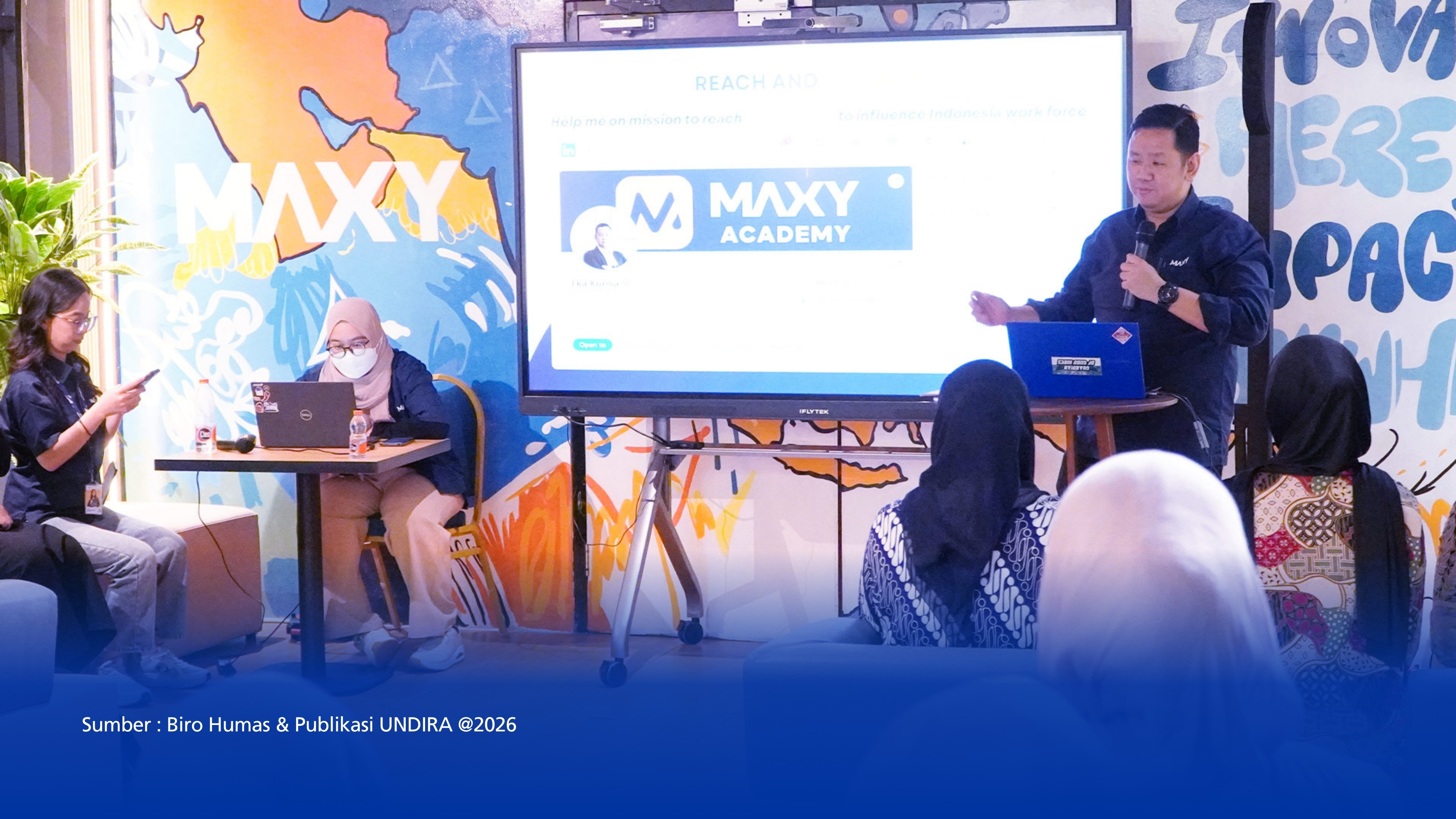
Strengthening AI Talent Competency and Career Readiness, MBKM and MKCU Centre of UNDIRA Holds Company Visit to Maxy Academy
Read more
Towards Optimal Development by Supporting Quality and Marketing, Enhancing Production With Management
Read more
Future Oriented vs Present Focused: Balancing Life Orientation
Read more
Campus Tanjung Duren
Jln. Tanjung Duren Barat II No. 1
Grogol, Jakarta Barat. 11470
Campus Green Ville
JIn. Mangga XIV No. 3
Campus Kranggan
Jln. Raya Kranggan, No.6,
Jatiraden, Kec. Jatisampurna, Bekasi. 17432


