

Article

Material Study 101: More Than Just an Accessory: Understanding the Secrets of Gold


 By :
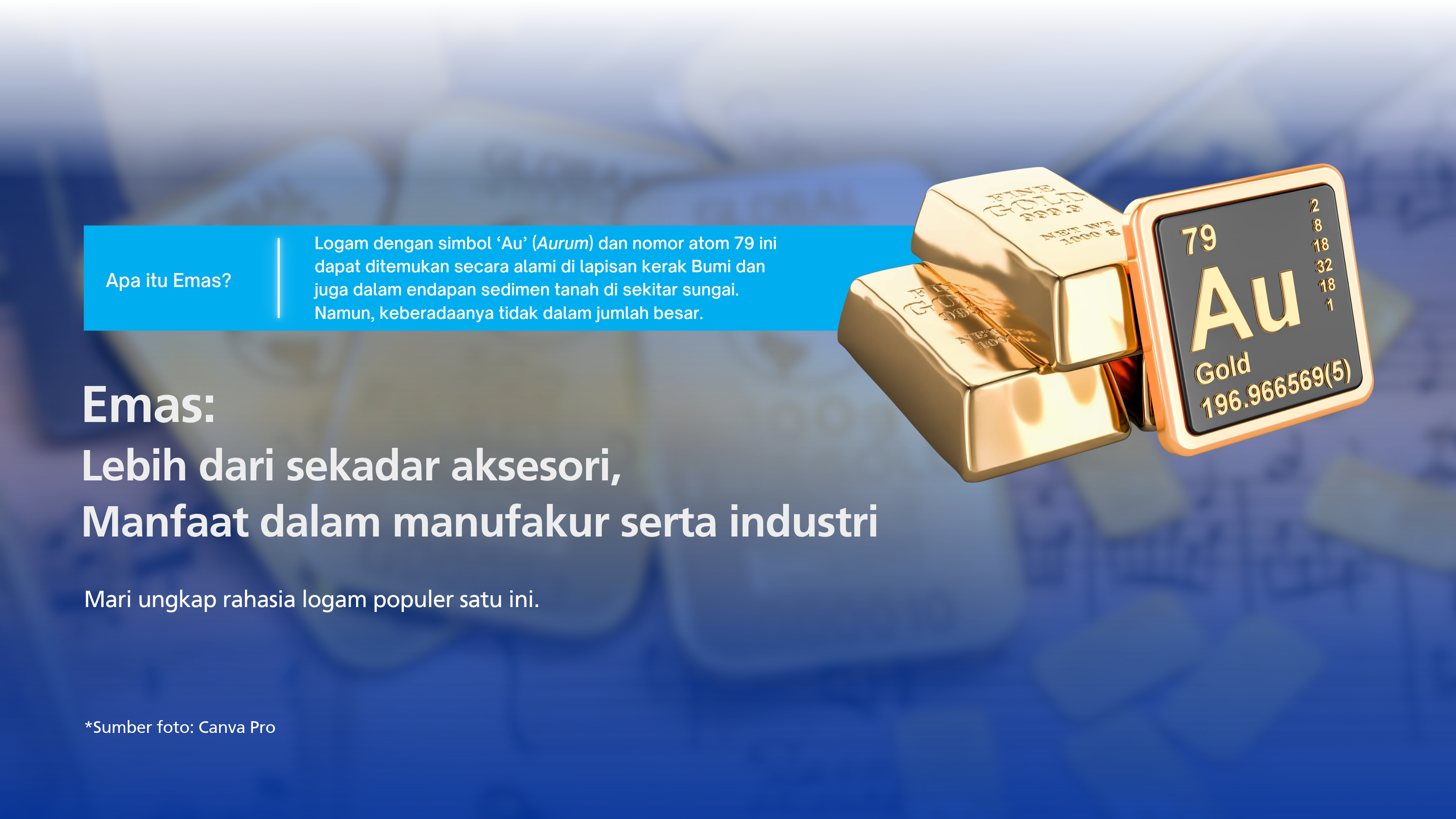
Gold, who doesn't know it? This metal, with the periodic table symbol "Au" (Aurum) and atomic number 79, occurs naturally in the Earth's crust and in the sediment deposits around rivers. In a stream, you can pan for gold with a simple pan and a bit of sifting. Even so, gold is hard to come by in large quantities. It usually takes heavy mining equipment, thorough geological surveys, and a fairly complex hydrometallurgical extraction process.
Besides being a decorative touch in jewelry and a tool of the economy, gold plays an important role in high-tech manufacturing. The ATM card you use (specifically, the gold-colored chip you can see with your own eyes) and even some of the electronic components you use day to day contain gold, you know. So what is it about this metal that makes it so useful in industry and manufacturing? Let's find out together, UNDIRA friends.
Gold has a rather unique origin story. According to research from NASA and LIGO/Virgo, gold didn't originate on Earth. The research suggests that gold (along with other heavy metals such as platinum) was born from a kilonova, a hugely energetic cosmic explosion caused by two neutron stars colliding (the GW170817 event), along with the gravitational waves it produced. In that event, neutron capture (the r-process) took place with other elements in space. Heavy dust was then flung outward and slowly clumped together as the planets formed. Millions of years ago, gold was gradually pushed closer to the Earth's crust through geological, volcanic, and tectonic activity, as well as hydrothermal flows.
With that background in mind, the next question is: "Why does modern manufacturing rely so heavily on gold?" The answer lies in the unique combination of its atomic structure and its chemical stability. Gold is a noble metal, which means it has a very positive standard reduction potential of +1.50 V. Put more simply, gold is happy to accept electrons from other elements but very reluctant to give up its own to react with things like oxygen and common acids. As a result, pure gold resists corrosion and oxidation for centuries, and it also has very high electrical and thermal conductivity. This is why a micro-thin layer of gold (applied through electroplating) is used on chip connectors, microprocessors, and motherboards, keeping signals flowing without interference from rust.
But that's only part of the story. Two other physical properties matter just as much in materials engineering: density and melting point. Gold is slightly denser than tungsten, at around 19.3 g/cm³, and far denser than other metals such as aluminum (2.7 g/cm³), iron (7.9 g/cm³), or copper (9 g/cm³). Unlike tungsten, though, which is brittle and hard to shape at room temperature, gold stays flexible despite its high density. The secret is its crystal structure, which is face-centered cubic (FCC). In an FCC structure, the atomic planes are tightly packed, so layers of atoms can slide past one another very easily without breaking the metallic bonds. That makes pure gold the most ductile and most malleable of all metals. Fun fact: a single gram of gold can be hammered into a thin, transparent sheet or drawn into a micro-wire more than two kilometers long, used to connect the circuits inside a semiconductor chip.
Finally, pure gold melts at 1,064 °C, which is quite moderate compared with other metals like titanium (1,668 °C) or tungsten (3,422 °C). This makes gold relatively easy to melt and cast without needing extreme amounts of energy or causing heavy air pollution. In a small jewelry workshop, melting can even be done with a gas torch, while industrial operations use high-capacity induction furnaces. Leftover pieces of pure gold can also be reworked with other metals such as nickel and palladium to make gold alloys, which look better and are a little more resistant to scratches. (For the record, pure gold only ranks 2.5 to 3 on the Mohs scale, while gold alloys can reach up to 4.)
Okay, now that we've covered its strengths, let's look at some of gold's weaknesses. As we've seen, gold is very hard to obtain in nature, and making synthetic gold is just as difficult because the process takes a great deal of energy to reach high quality. Its relatively low melting point also makes it a poor choice for withstanding extreme heat, such as in the filament of an incandescent bulb. On top of that, the lower the purity of the gold, the more likely it is to oxidize, which can also cause skin irritation in some people. Lastly, although gold conducts electricity well, it still falls behind copper and silver.
Sources of References:
Government of South Australia - Gold properties and uses
NASA - Where Does Gold Come From? NASA Data Has Clues
Abbott, B. P., et al. (LIGO Scientific Collaboration & Virgo Collaboration / NASA). (2017). Multi-messenger Observations of a Binary Neutron Star Merger. The Astrophysical Journal Letters, 848(2), L12.
Callister, W. D., & Rethwisch, D. G. (2020). Materials Science and Engineering: An Introduction (10th ed.). Hoboken, NJ: John Wiley & Sons.
Corti, C., & Holliday, R. (Eds.). (2010). Gold: Science and Applications. Boca Raton, FL: CRC Press.
University of Petrosani, Romania - Bolundut, I.-L. (2022). Gold: Properties, minerals, alloys, uses and recycling. Revista Minelor – Mining Revue, 28(2), 42–48. https://doi.org/10.2478/minrv-2022-0013
(Danang Respati Wicaksono and Mr. Adri Fato, S.T., M.T. - UNDIRA)
Press Contact :
Biro Humas & Sekretariat Universitas Dian Nusantara
Facebook : www.facebook.com/undiraofficial
Instagram : www.instagram.com/undiraofficial
Twitter : www.twitter.com/undiraofficial
www.undira.ac.id




Campus Tanjung Duren
Jln. Tanjung Duren Barat II No. 1
Grogol, Jakarta Barat. 11470
Campus Green Ville
JIn. Mangga XIV No. 3
Campus Kranggan
Jln. Raya Kranggan, No.6,
Jatiraden, Kec. Jatisampurna, Bekasi. 17432


