

Article

PHP2Shell and Remote Code Execution: Understanding Security Vulnerabilities in the Web Ecosystem


 By :
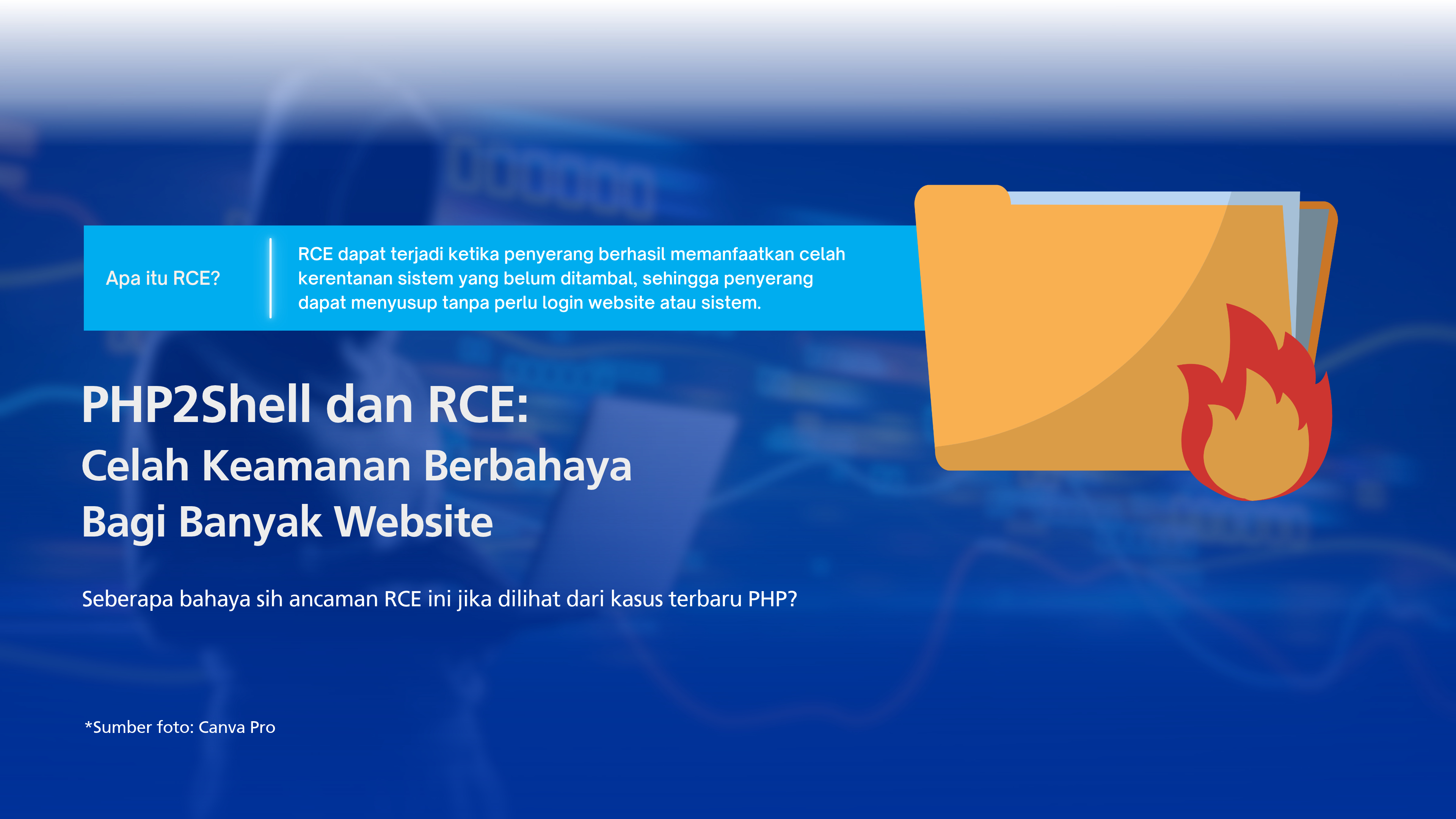
Some time ago, the digital world was shaken by the discovery of cybersecurity vulnerabilities affecting several websites across multiple countries, prompting some of them to be temporarily taken offline. According to various sources, the incidents were linked to vulnerabilities in frameworks and widely used programming languages that could be exploited through a technique known as Remote Code Execution (RCE). So, what exactly is RCE, and why can it pose such a serious problem? Let's take a closer look, Kawan UNDIRA.
First, it is important to understand that Remote Code Execution, commonly abbreviated as RCE, refers to the ability to execute code or programs on a target system remotely. In cybersecurity, RCE typically occurs when an attacker exploits an unpatched system vulnerability, allowing them to run unauthorized instructions without logging in. This can happen through techniques such as code injection, command injection, and insecure deserialization.
Now, let's take a closer look at RCE through the lens of a recent case. To begin with, Kawan UNDIRA should know that approximately 60–70% of websites and Content Management Systems (CMS) today rely on PHP. PHP itself has become an integral part of website development and operation, supporting everything from system management to database operations. Unfortunately, recent RCE attacks have exploited security vulnerabilities in PHP.
The problem originated from a recently discovered RCE vulnerability known as PHP2Shell, which exploits two security flaws: CVE-2026-109618 and CVE-2026-109619. In simple terms, both vulnerabilities take advantage of weaknesses in PHP's internal mechanisms that can arise when PHP improperly releases memory allocated to requests. Unfortunately, this can sometimes lead to memory corruption, creating an opportunity for malicious code to be injected and executed.
Once an attacker manages to inject malicious code, PHP may inadvertently execute it when attempting to refresh or process previously stored data. This is where things become particularly concerning, as attackers can potentially gain control over the server and even tamper with the affected website.
According to CVSS v4.0, these two vulnerabilities have severity scores ranging from 9.2 to 10, indicating that they pose a significant threat to system security and performance. Nevertheless, it is worth noting that not all RCE vulnerabilities carry the same level of risk.
Beyond compromising access to systems and websites, RCE attacks can also lead to several other consequences, including data breaches, the installation of persistent backdoors that may remain even after the latest security patches have been installed, and the exploitation of PHP2Shell as a stepping stone to infiltrate other websites with significant security weaknesses.
However, there is no need to panic, Kawan UNDIRA. RCE vulnerabilities can be mitigated through several preventive measures. One of the most important steps is to install the latest PHP versions available from GitHub, particularly PHP versions 8.5.12, 8.4.27, 8.3.36, or 8.2.35. After installation, make sure to take inventory of all previously installed PHP versions. Do not limit your security checks to internet-facing servers alone. Also inspect subdomains and built-in applications, particularly if you are using a hosting service. Check your web server directories for any unfamiliar or suspicious files as well. Finally, if no preventive measures have been implemented yet, consider temporarily disabling public access to the affected website.
The PHP2Shell case teaches us that even a seemingly minor flaw in code or memory management can be enough to disrupt websites across multiple countries. Behind every secure system is a software engineer who understands how software works down to its core: writing clean code, implementing secure coding practices, and promptly patching vulnerabilities before they can be exploited by malicious actors.
The Software Engineering concentration within the Informatics Engineering Study Program at Universitas Dian Nusantara is ready to be a place where you can develop your skills and grow. Here, you will gain a strong foundation in software engineering, preparing you to become a developer who does more than simply build functional systems, but also knows how to keep them secure. Don't wait until the next vulnerability emerges. Take your first step with UNDIRA and become part of a new generation of software engineers ready to safeguard the digital world.
Sources of Reference:
WatchTowr Official Website - Frequently Asked Questions About PHP Remote Code Execution (PHP2Shell CVE-2026-109618 & CVE-2026-109619)
CyberStudioID Instagram - PHP2Shell, Celah Keamanan Kritis Yang Bisa Diambil Alih
BloombergTechnoz Instagram - AI Temukan Titik Lemah di Pemrograman PHP, Jadi Incaran Peretas
0dayExploit101 Instagram - PHP2Shell
Mang Koding Instagram - 2 Celah Kritis Tanpa Login
(Bapak Giri Purnama - Danang Respati Wicaksono / UNDIRA)
Press Contact :
Biro Humas & Sekretariat Universitas Dian Nusantara
Facebook : www.facebook.com/undiraofficial
Instagram : www.instagram.com/undiraofficial
Twitter : www.twitter.com/undiraofficial
www.undira.ac.id




Campus Tanjung Duren
Jln. Tanjung Duren Barat II No. 1
Grogol, Jakarta Barat. 11470
Campus Green Ville
JIn. Mangga XIV No. 3
Campus Kranggan
Jln. Raya Kranggan, No.6,
Jatiraden, Kec. Jatisampurna, Bekasi. 17432


