

Article

Toward an Era of Energy Innovation: How Can Coal Be Converted into Fuel?


 By :
By : 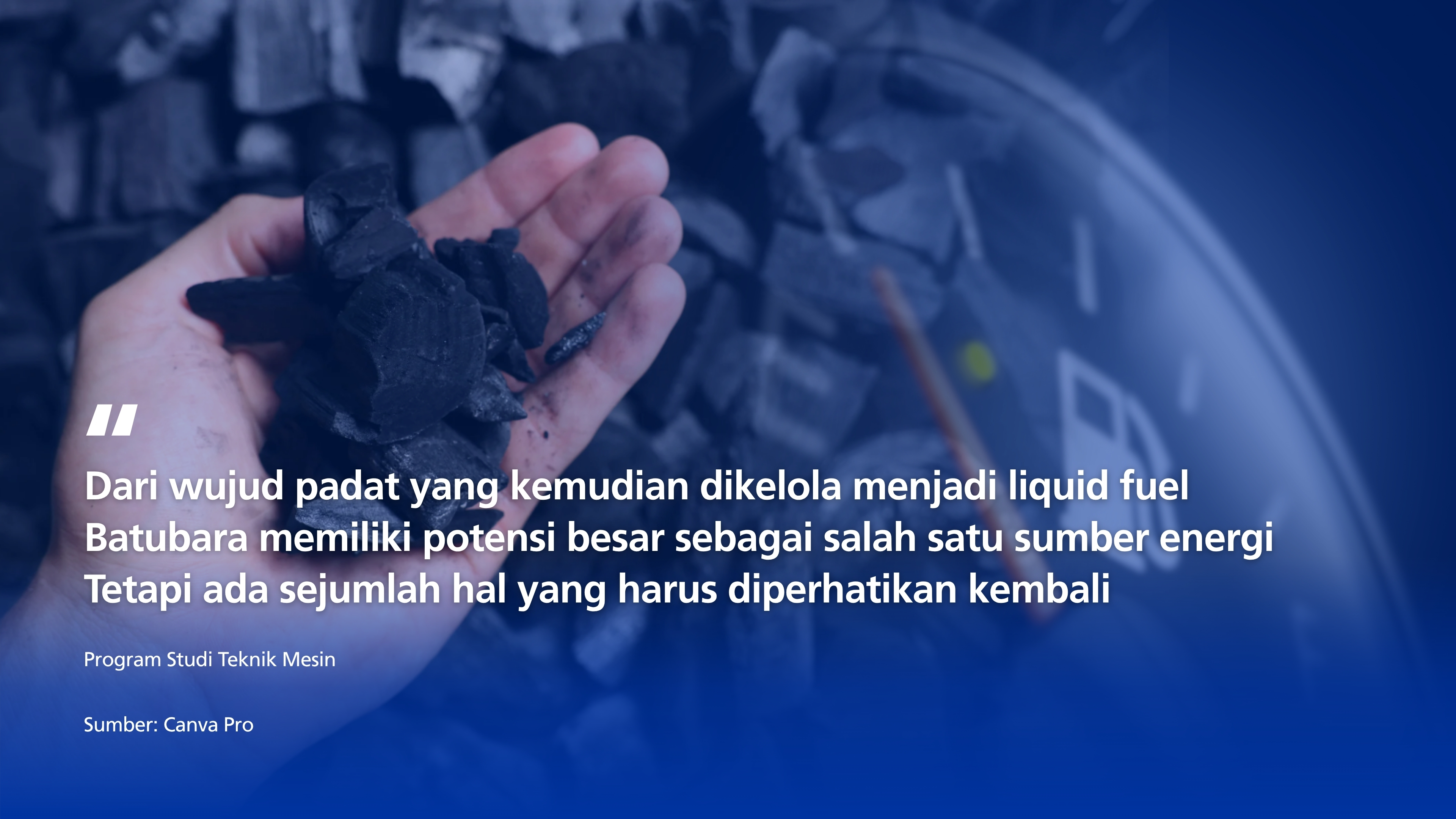
Energy is an indispensable resource that underpins modern life. Amid growing concerns about energy crises and geopolitical uncertainty that disrupt global energy supply chains, countries worldwide are racing to develop alternative and renewable energy solutions to prevent potential shortages.
As the search for new energy solutions and innovations continues, news recently emerged that Indonesia is considering using coal to produce motor vehicle fuel, commonly known as gasoline. Naturally, this raises a few questions: “How is that even possible? Gasoline is a liquid, while coal is a solid.” Others might wonder, “Turning coal into fuel sounds unusual. Would the resulting fuel be of good quality and safe for vehicles?” The short answer is yes, Kawan UNDIRA! Coal can be converted into liquid fuels through a technology known as Coal-to-Liquid (CTL).
Using coal to produce liquid fuel is not an entirely new concept. Around 1940, Germany had already pioneered coal-based fuel production as an alternative to increasingly scarce petroleum during World War II. The country employed coal liquefaction technology, which enabled it to produce approximately four million gallons of fuel. At the time, coal-derived fuels reportedly accounted for as much as 90% of Germany's total fuel consumption.
As mentioned earlier, coal can be converted into liquid fuel through Coal-to-Liquid (CTL) technology, which generally follows two pathways: direct and indirect conversion.
In the direct pathway, solid coal is converted directly into liquid without first undergoing gasification. The coal is exposed to hydrogen at temperatures of up to 450°C and pressures ranging from 14,000 to 20,000 kilopascals (kPa) for several hours. Under these conditions, the coal breaks down into hydrocarbon compounds. However, this process has its limitations, as only around half of the coal may be converted into liquid products.
In contrast, the indirect pathway begins by gasifying coal using oxygen and steam under high-temperature and high-pressure conditions. The reaction between coal, oxygen, and steam produces synthesis gas, commonly known as syngas, which consists primarily of carbon monoxide (CO) and hydrogen (H₂).
The syngas is then processed to produce methanol and its derivatives, such as dimethyl ether (DME), as well as liquid hydrocarbons. The chemical energy stored in the carbon (C) and hydrogen (H) bonds of these liquid hydrocarbons can subsequently be harnessed as fuel. When the fuel is burned inside an engine, this energy is released as heat, generating pressure that drives the pistons and enables the engine to operate.
From a fundamental chemical perspective, liquid fuels derived from coal can be suitable for use in vehicles because their hydrocarbon compounds can be similar to those found in conventional petroleum-based fuels. Although this technology is considered a potential alternative to conventional petroleum, several important factors still require careful evaluation, particularly its environmental impact during production and overall cost efficiency.
According to information reported by the Indonesian Association of Mining Experts (Perhimpunan Ahli Pertambangan Indonesia, or PERHAPI), although technologies capable of converting coal into liquid fuels are already available, the economic implications remain substantial. Both capital expenditure (CAPEX) and operational expenditure (OPEX) can be significant. Furthermore, converting coal into fuel inherently generates considerable greenhouse gas emissions, particularly carbon dioxide. The overall carbon footprint of the process must therefore be carefully assessed before the technology can be considered a viable long-term solution.
This is where the Mechanical Engineering Study Program at Universitas Dian Nusantara (UNDIRA), particularly its Energy Conversion concentration, plays an important role. Kawan UNDIRA, the thermodynamics, heat transfer, and combustion engineering principles you study are more than just classroom theories. They provide the foundation for improving process efficiency, recovering waste heat, reducing emissions, and integrating fossil fuels with renewable energy sources.
Through your experiences in classrooms and laboratories, become part of a generation of innovators helping Indonesia move toward a smarter, cleaner, and more sustainable era of energy innovation with UNDIRA.
Sources of Reference:
Economic analysis of unconventional liquid fuel sources - ScienceDirect
Coal Liquefaction - Student Energy
Wacana RI Ubah Batu Bara Jadi Bensin, Begini Prosesnya - PERHAPI
(Danang Respati Wicaksono / Humas UNDIRA)
Press Contact :
Biro Humas & Sekretariat Universitas Dian Nusantara
Facebook : www.facebook.com/undiraofficial
Instagram : www.instagram.com/undiraofficial
Twitter : www.twitter.com/undiraofficial
www.undira.ac.id
Other

The Spirit of Red and White Across the Sky: Moving Forward Together Towards Sovereignty and Prosperity
Read more
Develop Cross-Disciplinary Skills: Preparing Students for the World of Work
Read more.jpg)
The Influence of Language and Context on Perception and Response in Social Media and Social Interactions
Read more
Campus Tanjung Duren
Jln. Tanjung Duren Barat II No. 1
Grogol, Jakarta Barat. 11470
Campus Green Ville
JIn. Mangga XIV No. 3
Campus Kranggan
Jln. Raya Kranggan, No.6,
Jatiraden, Kec. Jatisampurna, Bekasi. 17432


