

Article

Understanding Ludonarrative: How Video Games Bring Literature to Life in Digital Interactive Art


 By :
By : 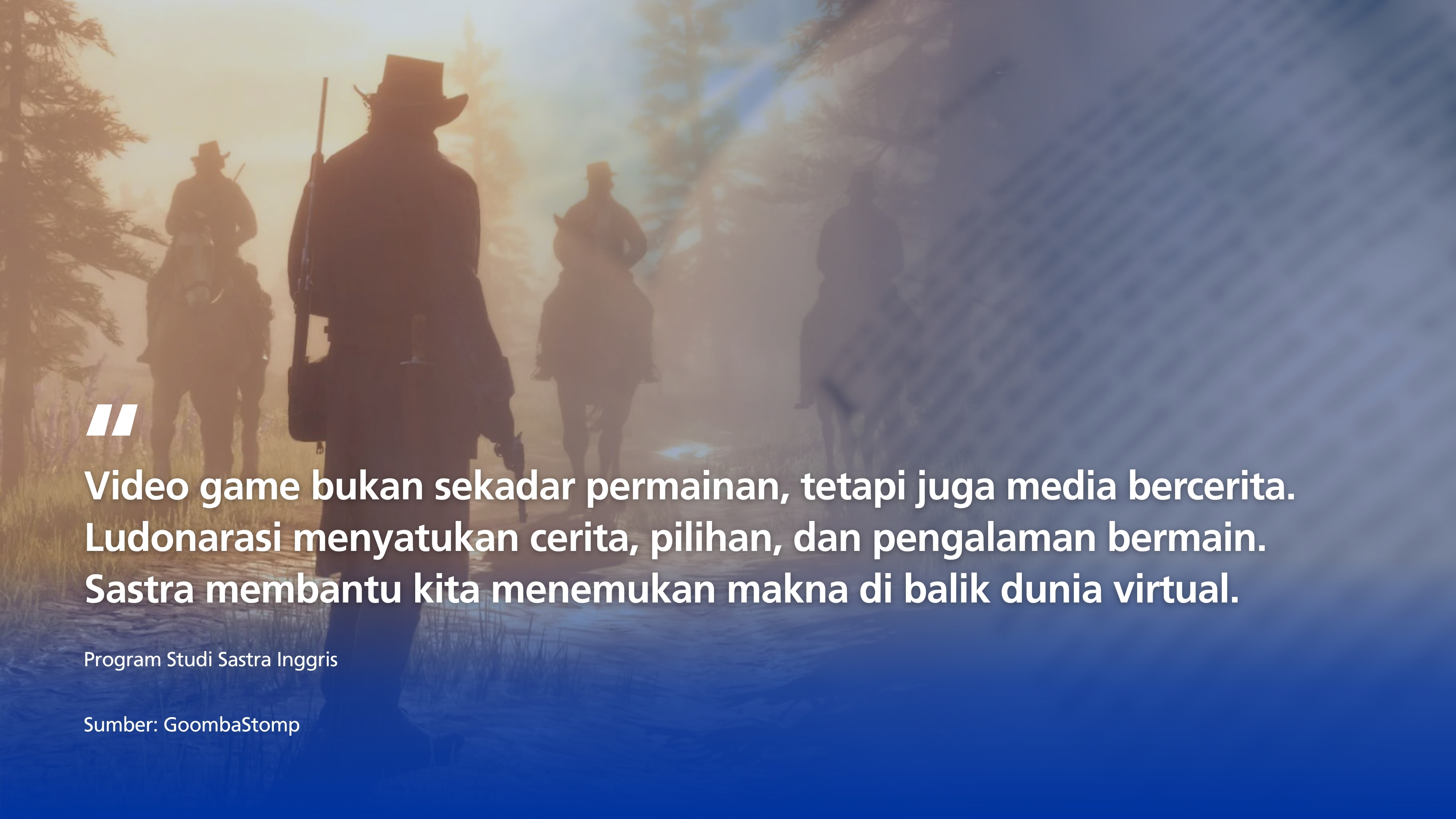
Literature, as we understand it, not only reveals critiques of texts themselves but also the diverse histories, ideas, and social and cultural perspectives of humanity throughout the ages. In the modern era, the study of literature is certainly not limited to books alone but extends to various other media channels as well. Amid the rapid development and acceleration of digitalization, one form of modern literature that is now gaining significant attention is the video game.
Although viewed by the general public as merely a form of entertainment, the narrative complexity, interactivity, and world-building concepts presented by video games not only enhance the gaming experience but also establish video games as a distinct form of popular modern literature through the social, ideological, and cultural frameworks they incorporate from around the world.
Video games don’t just convey narratives through dialogue, UNDIRA friends. Unlike novels or short stories, which place the reader in a passive role, video games position the player as an active participant capable of driving and developing the story, both through the narrative arc and through interactions with the game’s mechanics, in order to convey the full literary context. This relates to research on games and gameplay mechanics, specifically, ludonarrative studies, which examine the relationship between gameplay and narrative elements in video games.
At its core, ludonarrative analysis examines various elements within video games and other fictional works. Ludonarrative describes the interconnection between the concept of the ludic (play) and the concept of the narrative (story) within a video game. When a story or the overarching narrative theme of a video game aligns with its gameplay mechanics, this is referred to as “ludonarrative resonance.”
The Witcher is one example of a video game that meets the criteria for ludonarrative resonance; that is, when the gameplay and the story are in harmony. Set in the Middle Ages and inspired by European mythology and history, this game’s harmony is evident in its mechanics, such as magic, alchemy, and the hunt for monsters and mythological creatures, all of which align with the storyline of Geralt of Rivia, the main character.
Another example of ludonarrative resonance is Red Dead Redemption II. In that game, the gameplay becomes more challenging as the protagonist, Arthur Morgan, suffers from worsening tuberculosis. As a result, the protagonist becomes increasingly vulnerable as the story of Red Dead Redemption II unfolds.
Well, UNDIRA friends, after examining several aspects of ludonarrative resonance, let’s now discuss what happens when a video game’s narrative or thematic foundation is out of sync with its gameplay mechanics. This is known as ludonarrative dissonance.
The term “ludonarrative dissonance,” popularized by game designer Clint Hocking in 2007 through his critique of BioShock, describes a situation where the narrative and the game’s mechanics contradict one another. For example, a character portrayed as moral and empathetic is, within the game, free to commit unlimited acts of violence. This criticism actually highlights that video games are now judged by serious standards—namely, how consistently form and content support one another—just as we evaluate literary works in general. Another example appears in games like Uncharted, where the protagonist, Nathan Drake, has a moral compass that leans toward pacifism, yet the game's structure and mechanics allow players to commit violence to survive.
Ludonarasi offers a much more comprehensive perspective on how we can situate literary studies within a broader context. For literary scholars, video games certainly cannot universally replace the role of books, but their existence as a literary medium increasingly reflects diverse moral and cultural perspectives, further emphasizing that behind the millions of pixels in a digital work, there are still reflective ideas and narratives worth examining.
For UNDIRA students interested in the world of literature and its study, the English Literature Program at Dian Nusantara University (UNDIRA) may be the right choice for you to pursue as you embark on a journey of studying, researching, and, someday, developing your literary spirit. Write your story; begin your art with UNDIRA.
Sources of Reference:
Ludonarative Explained Thoroughly - StudysmarterUK
Games as Literature 101 - Ludonarrative Harmony - Games as Literature YouTube Channel
(Danang Respati Wicaksono / Humas UNDIRA)
Press Contact :
Biro Humas & Sekretariat Universitas Dian Nusantara
Facebook : www.facebook.com/undiraofficial
Instagram : www.instagram.com/undiraofficial
Twitter : www.twitter.com/undiraofficial
www.undira.ac.id
Other

Strengthening Academic Downstreaming and Public Literacy, UNDIRA Library Achieves Recognition in the University Library Innovation Competition
Read more
One Accessibility for All: UNDIRA Lecturer Assesses User Satisfaction of SLiMS 9 Information Management System via the End-User Computing Method
Read more
FTI UNDIRA Expands Global Network: Signs Strategic Partnership with Politeknik Ungku Omar Malaysia and Participates in IEEE Day 2025
Read more
Campus Tanjung Duren
Jln. Tanjung Duren Barat II No. 1
Grogol, Jakarta Barat. 11470
Campus Green Ville
JIn. Mangga XIV No. 3
Campus Kranggan
Jln. Raya Kranggan, No.6,
Jatiraden, Kec. Jatisampurna, Bekasi. 17432


