

Article

Behind the Acceleration of Data Center Innovation: A New Dilemma for Natural Resources?


 By :
By : 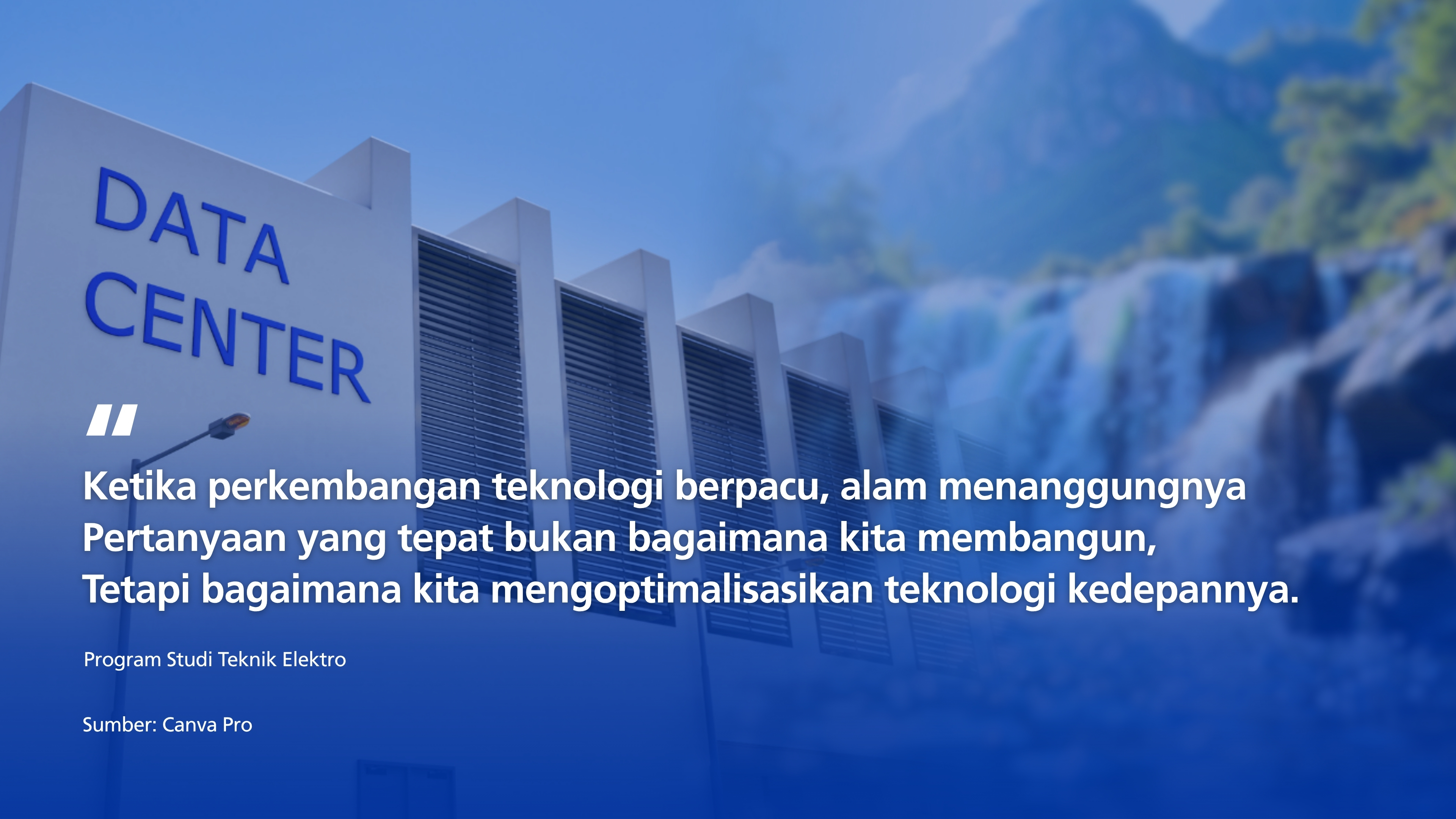
When we hear discussions about data centers, our understanding often revolves around rows of servers, cables, and blinking indicator lights inside large facilities. Yet a data center is much more than that. It functions as a digital ecosystem responsible for storing information, maintaining its availability, and even powering artificial intelligence (AI) around the clock.
While data centers can support nearly every aspect of modern industry and continue to attract significant investment, their growing presence also reveals a less visible reality: the more intensive the computational processes become, the greater the energy and maintenance requirements needed to keep these facilities running.
According to a study published by the International Energy Agency (IEA), data centers around the world consumed approximately 415 terawatt-hours (TWh) of electricity in 2024, accounting for roughly 1.5% of global electricity consumption. This figure is expected to continue growing as data center infrastructure expands across countries. As a direct example, Meta’s data center in Louisiana, United States, is estimated to require up to 7.5 gigawatts of electricity, a demand that is significantly greater than the electricity consumption of the city of New Orleans.
Beyond their substantial electricity consumption, data centers also require a large and consistent supply of water. This is because continuous computing generates significant amounts of heat. As a result, water is often used to maintain stable temperatures across the various components and machines within a data center. A single large-scale data center is estimated to require around 19 million liters of water per day.
From an environmental perspective, the demand for water has also sparked concerns, particularly regarding potential impacts on clean water sources and the availability of water for surrounding communities. While skepticism surrounding data center development can be found in many places, the resource consumption associated with these facilities can be reduced through the right approaches.
One potential solution is the use of an Immersion Cooling Method. By using a Dielectric Liquid, a non-conductive fluid, computing equipment can be immersed in the liquid to improve heat dissipation while reducing reliance on local water supplies. Unlike conventional water-based cooling systems, dielectric liquids are specialized synthetic fluids designed specifically for this purpose.
The second approach is improving computational efficiency. Data centers should consume resources in proportion to actual computational demand. More efficient AI models, scheduling workloads during periods when cleaner energy is available, and removing unnecessary stored data can all help reduce resource requirements further upstream.
The third approach is to promote the use of renewable energy, such as solar panels, while also exploring ways to recover and reuse the thermal energy generated by data centers themselves.
Ultimately, data centers are not merely a technological issue; they are also a matter of sustainability. The acceleration of digital innovation and AI may be difficult to stop, but the way we support that growth is still a choice. Immersion cooling, computational efficiency, and renewable energy demonstrate that technological progress and the preservation of natural resources do not necessarily have to work against each other. The challenge is ensuring that these solutions are properly designed, implemented, and managed by people who understand the technology behind them.
Through its two complementary concentrations, Electronics and Electrical Power, the Electrical Engineering Study Program at Universitas Dian Nusantara (UNDIRA) equips students with up-to-date competencies in the application, understanding, and optimization of technology. Both concentrations are further strengthened through intensive learning in the field of Internet of Things (IoT), enabling students to become familiar with developing systems capable of monitoring, analyzing, and optimizing energy consumption intelligently and in real time.
With these competencies, Electrical Engineering graduates are expected to become more than technology users. They are prepared to become solution designers who can help ensure that the growth of data centers continues to go hand in hand with the sustainable use and preservation of natural resources.
Sources of Reference:
Menakar Dampak Ekologis Pembangunan Data Center AI di Jatiluhur - TirtoID
Energy demand from AI - International Energy Agency (IEA)
Peran Liquid Cooling (Direct-to-Chip) dalam Mengoptimalkan Efisiensi Energi Data Center AI
(Danang Respati Wicaksono / Humas UNDIRA)
Press Contact :
Biro Humas & Sekretariat Universitas Dian Nusantara
Facebook : www.facebook.com/undiraofficial
Instagram : www.instagram.com/undiraofficial
Twitter : www.twitter.com/undiraofficial
www.undira.ac.id
Other

Building a Generation of Integrity and Global Competitiveness, UNDIRA Partners with TNI AD and LLDikti to Strengthen Student Character
Read more.jpg)
Maintaining Idealism or Maintaining Life: The Job Hugging Phenomenon in the Midst of Society 5.0
Read more
The 1st Anniversary and Opening Ceremony for New Students of Universitas Dian Nusantara for the Odd Semester of the 2020/2021 Academic Year
Read more
Campus Tanjung Duren
Jln. Tanjung Duren Barat II No. 1
Grogol, Jakarta Barat. 11470
Campus Green Ville
JIn. Mangga XIV No. 3
Campus Kranggan
Jln. Raya Kranggan, No.6,
Jatiraden, Kec. Jatisampurna, Bekasi. 17432


