

Article

From a Generational Cultural Heritage to a Creative Economy Hub: Lasem, a Cultural Heritage and Center of Creativity


 By :
By : 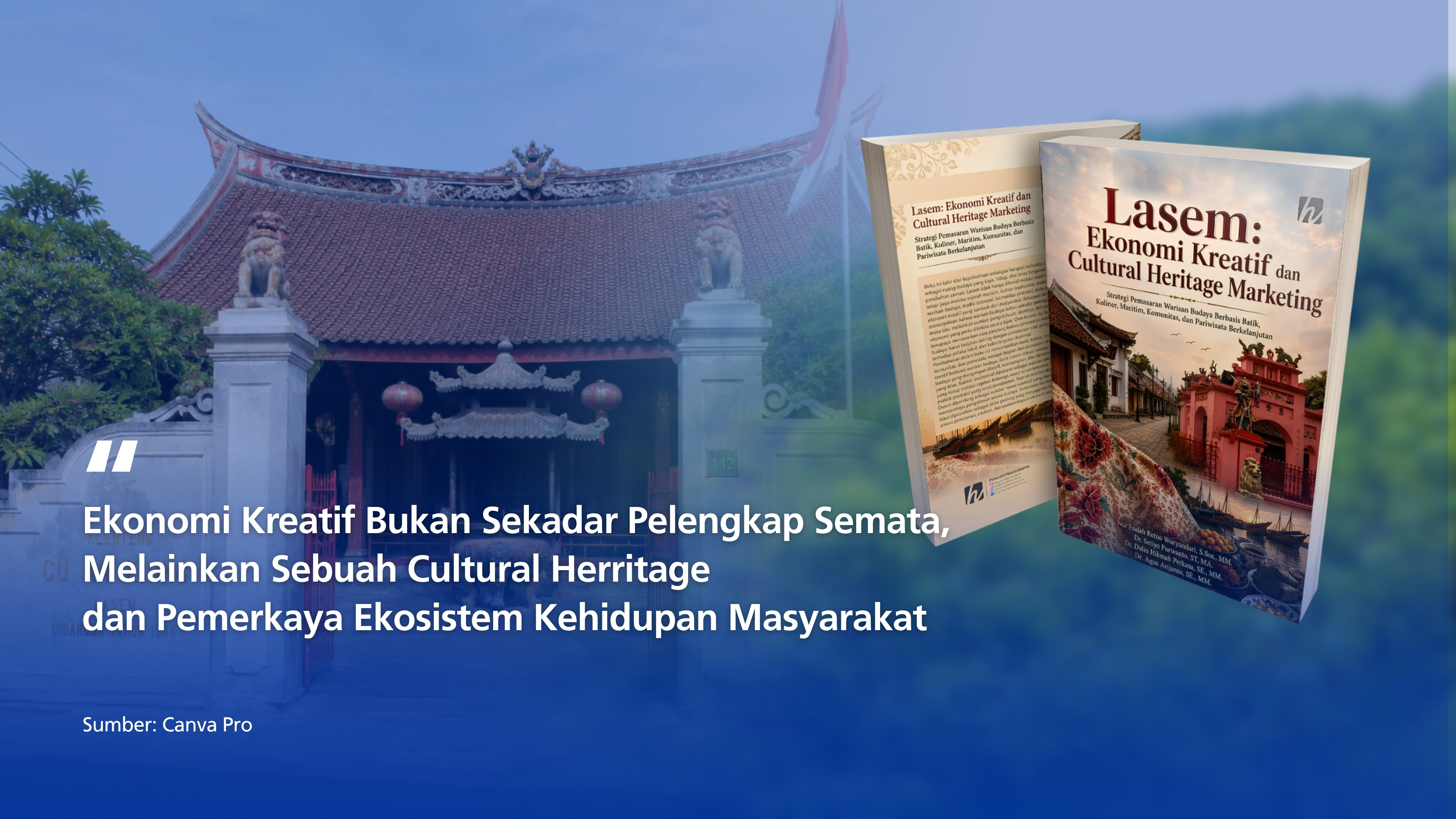
As globalization continues to expand and industries grow alongside the increasing exposure of communities to diverse information and cultures, economies and the ways people make use of them are naturally evolving to adapt to changing needs. This shift is closely connected to what is commonly known as the creative economy.
In a monograph written by Nur Endah Retno Wuryandari, S.Sos., M.M., a lecturer in the Management Study Program at Universitas Dian Nusantara (UNDIRA), the creative economy can essentially be understood as a process of creating value rooted in human ideas, knowledge, and creativity. One of its defining characteristics is the dominance of valuable intangible assets.
The creative economy is not merely about branding historical and cultural destinations. It can also serve as a means of revitalizing economic growth by harnessing the creativity and intellectual capital of local communities. This perspective is in line with Article 1 of Law No. 24 of 2019, which recognizes the cycle of creating and distributing creativity and intellectual capital. The 2024 Creative Economy Outlook also highlights the creative economy as one of the influential catalysts for economic growth while contributing to greater diversity in trade.
One example of a thriving creative economy can be found in Lasem, a coastal town in Central Java. Known as a silent witness to the historical encounter between two major ethnic communities, Javanese and Chinese, Lasem, often referred to as “Little China,” has developed a rich cultural landscape shaped by the interaction and blending of these communities.
According to Wuryandari’s monographic study on the creative economy, Lasem’s potential as a creative economy hub lies in its ability to manage and develop local cultural heritage into various forms of economic value without sacrificing its historical character and cultural identity. This potential can be seen in both tangible and intangible forms of heritage. Tangible heritage includes various historical remnants found throughout Lasem, while intangible heritage can be seen in the local folklore passed down through generations and the cultural knowledge embedded in Lasem batik. Its iconic Hong bird motif, for instance, represents a distinctive form of interethnic heritage marketing while reinforcing Lasem’s identity as a harmonious cultural intersection.
Adding to this potential is Lasem’s strategic geographical position along the North Coast Road of Java (Pantura), between Semarang and Surabaya. This location brings together many of the town’s cultural and economic assets. Since the Majapahit era, Lasem has been home to two major ports, Regol and Kaeringan (also known as Kairingan), which connected Chinese, Arab, and European traders through the Lasem and Babagan rivers.
This legacy of connectivity continues through the modern Pantura route, which provides convenient access from major cities. Lasem’s appeal is further enriched by coastal landscapes such as Karang Jahe and Caruban beaches, as well as the Watu Layar hills. Together, these features make Lasem not only accessible but also capable of offering a diverse range of tourism experiences for different visitor segments.
It is this synergy between batik, architecture, and geography that has allowed Lasem to evolve from a center of generational cultural heritage into a sustainable creative economy hub, as discussed in Nur Endah Retno Wuryandari’s monograph. However, maintaining this transformation requires continued collaboration among the government, businesses, and local communities to ensure that Lasem’s historical values remain protected.
Ultimately, the story of Lasem presented through Wuryandari’s monograph reminds us that cultural heritage is not a frozen artifact meant only to be remembered. Rather, it is a living force that continues to sustain the existence and identity of a community across generations. The acculturated motifs of its batik, the architecture of its temples and historic houses along the coast, and the folklore passed down from one generation to another all represent the cultural heartbeat of Lasem, affirming who its people are and where they come from.
When this cultural heartbeat is thoughtfully managed through the lens of the creative economy, heritage is no longer merely an object of nostalgia. It can become productive intellectual capital that generates economic value without sacrificing its historical soul.
This is the true essence of the creative economy: not exploiting the past, but nurturing it so that it can continue to breathe and remain relevant amid the ever-changing currents of time.
Source of Reference:
Wuryandari, N. E. R., Purwanto, S., Perkasa, D. H., & Arijanto, A. (2026). Lasem: Ekonomi kreatif dan cultural heritage marketing: Strategi pemasaran warisan budaya berbasis batik, kuliner, maritim, komunitas, dan pariwisata berkelanjutan.
(Danang Respati Wicaksono / Humas UNDIRA)
Press Contact :
Biro Humas & Sekretariat Universitas Dian Nusantara
Facebook : www.facebook.com/undiraofficial
Instagram : www.instagram.com/undiraofficial
Twitter : www.twitter.com/undiraofficial
www.undira.ac.id
Other
.jpg)
Understanding vs. Memorizing: Which Is Better for University Students' Learning?
Read more
UNDIRA Lecturer’s Research Reveals the Most Effective Digital Marketing Strategy: Organic, Paid, or a Combination?
Read more
Mechanical Engineering and its Innovation Implementation in Modern Work Environment
Read more
Campus Tanjung Duren
Jln. Tanjung Duren Barat II No. 1
Grogol, Jakarta Barat. 11470
Campus Green Ville
JIn. Mangga XIV No. 3
Campus Kranggan
Jln. Raya Kranggan, No.6,
Jatiraden, Kec. Jatisampurna, Bekasi. 17432


