

Research and Innovation

From Feedback and Impressions to Actionable Data: Revealing Lecturer Performance Through Text Mining Analysis


 By :
By : 
At the end of each semester, lecturers routinely conduct evaluations to ensure that their performance and the learning materials they deliver meet students’ needs and institutional standards. This process is not merely a formality, but an important effort to maintain and continuously improve the quality of teaching and the academic standards of the study program.
Traditionally, surveys based on yes-or-no questions or numerical rating systems, such as the Likert scale, have been the primary methods used to collect student feedback. However, one limitation of these approaches is that they tend to prioritize efficiency and ease of measurement over a comprehensive representation of students’ opinions and experiences. In response to this limitation, a growing number of institutions have begun adopting comment-based feedback forms that allow students to express their views more freely.
Although open-ended comments are generally considered more representative of students’ actual experiences, their biggest challenge lies in managing qualitative datasets through manual analysis, particularly when the volume of responses becomes substantial.
In response to this challenge, a team of lecturers and researchers from Universitas Dian Nusantara, Universitas Sjakhyakirti, Universitas Bina Nusantara, and Universitas Muhammadiyah Bengkulu sought to develop a solution that could process and interpret the information contained in student feedback more effectively and efficiently through automation. This effort led to a research study focusing on the application of Text Mining techniques.
Fundamentally, Text Mining is a technique used to process and analyze textual data by identifying patterns, sentiments, and information within relatively unstructured datasets. Its application in this context aims to transform raw student feedback into analytical outputs that can provide meaningful insights and support evidence-based decision-making in the future.
Over the past four years, numerous studies on Text Mining have been developed using a wide range of approaches. One study by Abdi et al. (2023), for example, demonstrated potential for supporting automated interpretation. However, its model, which combined Word Embedding with a Convolutional Neural Network (CNN) and Bidirectional Long Short-Term Memory (BiLSTM), was considered relatively computationally intensive.
Furthermore, several existing models have been designed to identify only one or two key aspects of student comments. Ideally, however, an effective model should be capable of addressing all four core lecturer competencies: pedagogical, professional, personal, and social competencies. Another limitation of previous approaches is their limited ability to effectively process and analyze Indonesian-language data.
Building on these research gaps, the present study addresses the limitations by comparing four deep learning architectures: Long Short-Term Memory (LSTM), Bidirectional Long Short-Term Memory (BiLSTM), one-dimensional Convolutional Neural Network (CNN1D), and Recurrent Neural Network (RNN). These architectures were combined with the Word Embedding Text to Sequence (WETS) technique to enable the models to process Indonesian-language text effectively while generating representations of the four lecturer competencies from descriptive feedback provided by students.
The study began with the distribution of a questionnaire, which ultimately generated approximately 6,140 validated responses. Before the data could be further analyzed and used for algorithm training and testing, it underwent five preprocessing stages: Data Cleansing, Case Folding, Stopword Removal, Tokenizing, and Stemming. Once these five stages were completed, the processed data were subsequently transformed using the WETS technique.
Following the WETS transformation, the four deep learning architectures—RNN, CNN1D, LSTM, and BiLSTM—were independently tested using the same dataset. This process was conducted to evaluate the performance of each model in identifying positive and negative sentiment patterns within student feedback.
The results showed that, among the four models, the WETS-LSTM combination achieved the highest test accuracy, reaching 82.92%, despite obtaining a lower training score than the WETS-BiLSTM model. This finding suggests that LSTM demonstrated stronger resistance to overfitting, greater predictive accuracy, and better generalization of Indonesian-language patterns compared with the other evaluated models.
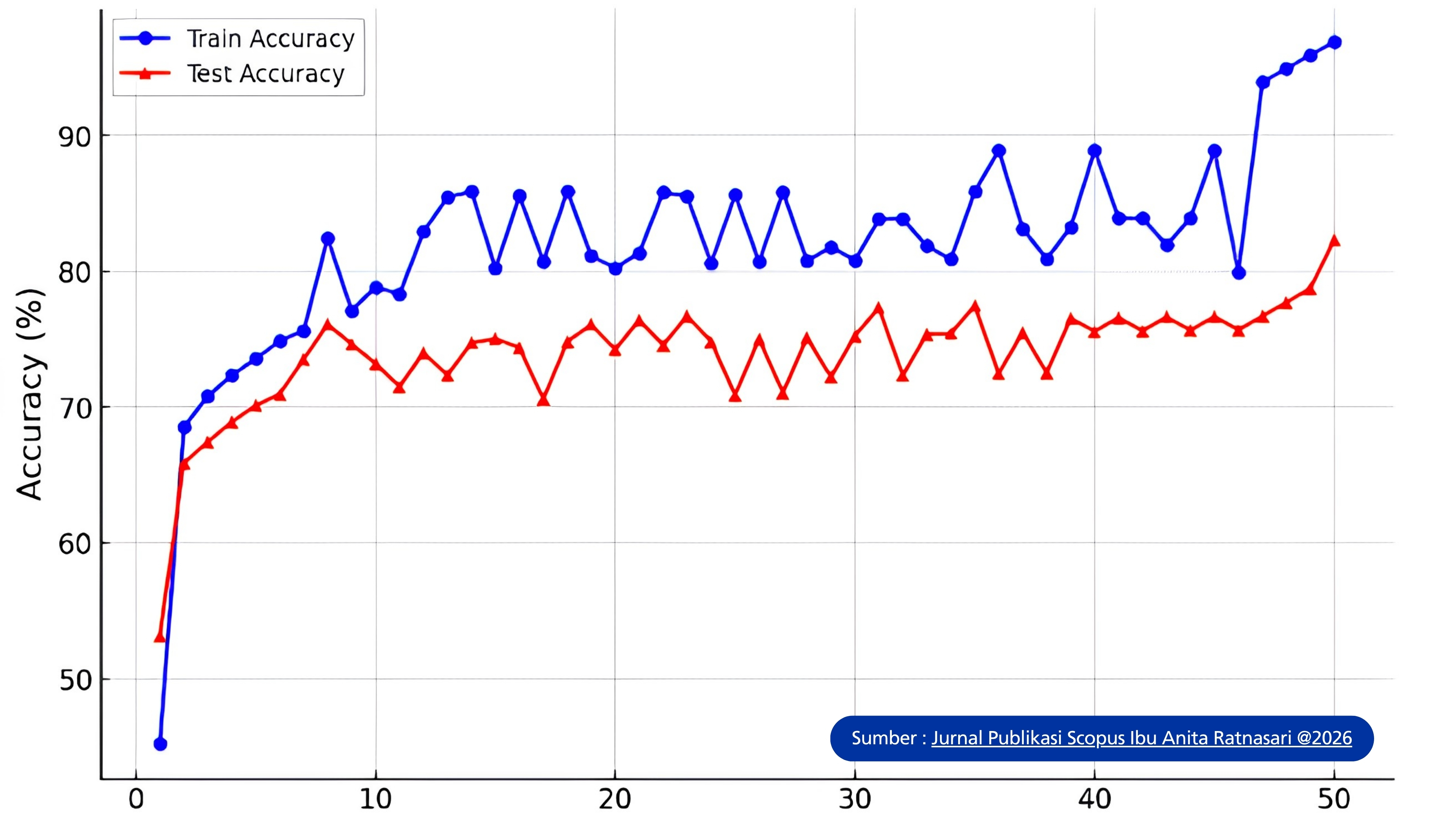
(Accuracy of WETS-LSTM for dataset of social feedback)
Through the comparative evaluation of these models, the study—which has also been published in the International Journal of Advanced Computer Science and Applications (IJACSA), a Scopus Q3-indexed journal—is expected to contribute to the advancement of data management, particularly in the automated processing and analysis of qualitative textual data. Beyond its research contribution, the proposed combination of algorithms may also serve as a reference for developing practical approaches to qualitative data management in the future, particularly for system developers, researchers, and data scientists seeking to transform unstructured textual feedback into meaningful and actionable insights.
Source of Reference:
Press Contact :
Biro Humas & Sekretariat Universitas Dian Nusantara
Facebook : www.facebook.com/undiraofficial
Instagram : www.instagram.com/undiraofficial
Twitter : www.twitter.com/undiraofficial
www.undira.ac.id
Other
Materials 101: Understanding Asbestos in Construction: Benefits, Risks, and Modern Material Alternatives
Read more.jpg)
Stay Alert! Protect Our Data and Devices Together: Let’s Get to Know the Different Types of Cyberattacks!
Read more
Halalbihalal & NBO's 5th Anniversary: Strengthening Bonds and Embracing Togetherness in the Frame of Spirituality and Culture
Read more
Campus Tanjung Duren
Jln. Tanjung Duren Barat II No. 1
Grogol, Jakarta Barat. 11470
Campus Green Ville
JIn. Mangga XIV No. 3
Campus Kranggan
Jln. Raya Kranggan, No.6,
Jatiraden, Kec. Jatisampurna, Bekasi. 17432


