

Research and Innovation

Supporting Agriculture With Precision, UNDIRA Electrical Engineering Student and Lecturer Develop Automated Plant Watering System


 By :
By : 
As interest in the agricultural sector continues to grow, maintaining consistent watering and proper care for crops and cultivated land has become a key concern for botanists and growers. Every plant has its own specific requirements, particularly when it comes to cultivation and maintenance. Soil moisture, irrigation systems and intensity, as well as the surrounding biological ecosystem, all need to be carefully maintained to ensure that plants remain in optimal condition.
One high-value horticultural commodity is shallot, scientifically known as Allium cepa L. var. aggregatum. Shallots are widely cultivated and sought after due to their importance as a food ingredient as well as their potential to provide a profitable source of income for farmers and growers.
However, cultivating shallots comes with several factors that require close attention. These include planting distance, watering intensity, water level, soil moisture, which should generally remain within the range of 50–70%, and temperature, which should not exceed 32°C. In addition, manual monitoring and watering, combined with increasingly unpredictable weather conditions, can make the cultivation of horticultural commodities more challenging.
To address these challenges, Andre Dwi Ichwantyo, a student of the Electrical Engineering Study Program, together with his academic advisor, Randy Rahmanto, S.T., M.T., an Electrical Engineering lecturer, developed an automated plant watering system based on an Arduino Uno microcontroller called Smart Garden.
According to the research published in Jurnal Energi, Volume 2, Issue 1, in January 2026, the innovation was developed using a Research and Development (R&D) approach. The development process involved collecting a number of local data samples, which were then used as the basis for designing and refining the system.
The Smart Garden system utilizes an Arduino Uno R3 microcontroller as the “brain” responsible for controlling the overall operation of the system. To further optimize its performance, the prototype is equipped with three additional sensors: a DHT11 sensor, an HC-SR04 ultrasonic sensor, and an FC-28 soil moisture sensor.
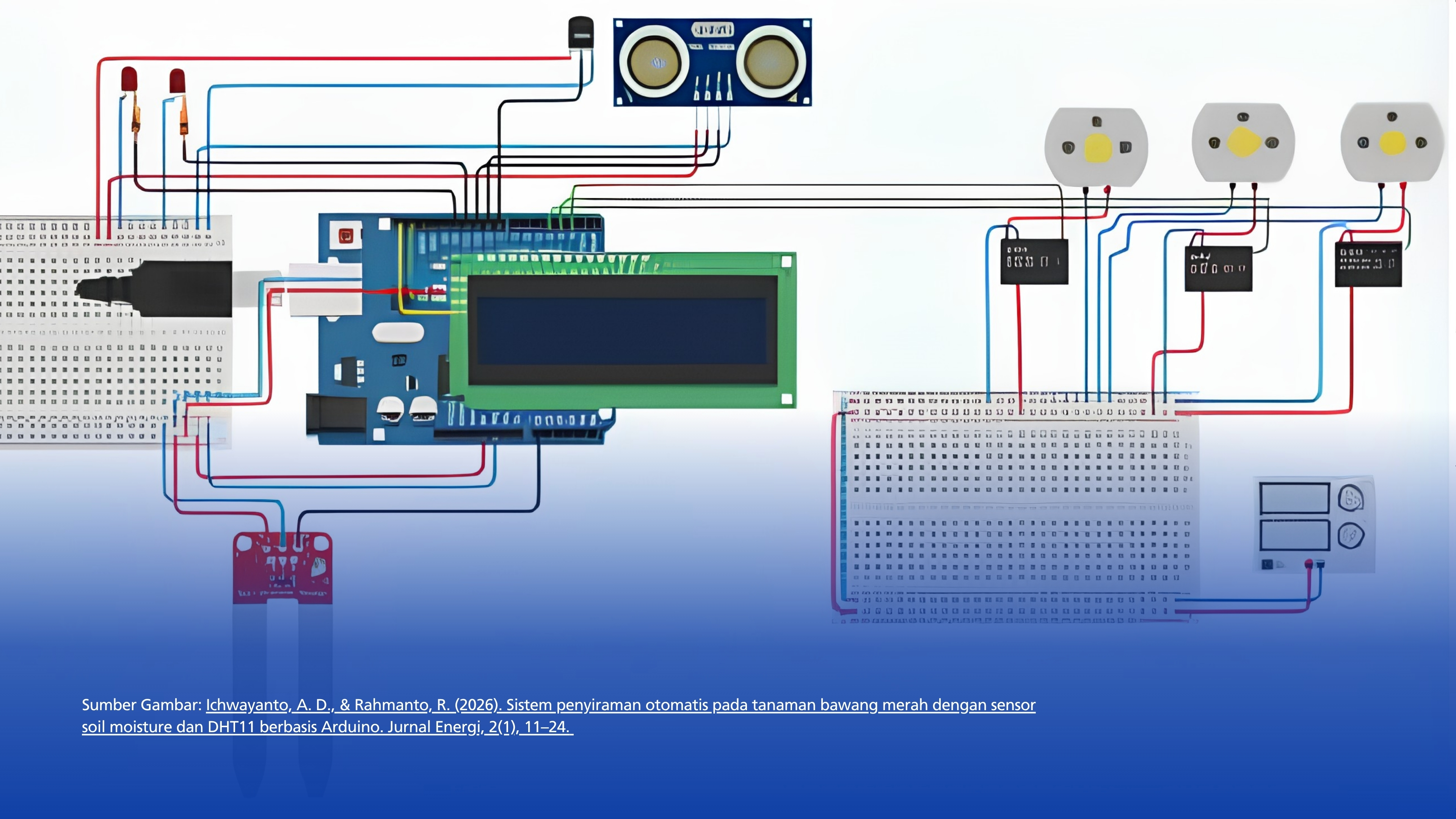
(Prototype's Schematics)
The DHT11 sensor allows the device to monitor the surrounding air temperature and humidity. Meanwhile, the ultrasonic sensor measures the water level, enabling the system to automatically manage watering for shallot plants while maintaining precise control over the amount of water supplied. The FC-28 sensor, on the other hand, detects soil moisture. Although relatively simple, the sensor is capable of monitoring soil moisture on a small scale, making it suitable for use in urban growing environments.
The data collected by all sensors is then processed by the system to control a DC pump motor, which operates the water pump and cooling fan according to the environmental conditions detected by the sensors.
During field testing, the prototype was deployed in an environment with predetermined operating thresholds. The test results showed that the watering system could be activated automatically when the soil moisture sensor indicated dry conditions, with a sensor reading above the threshold of 700, provided that the water reservoir contained sufficient water to maintain the required moisture level.
To help maintain temperature stability, the cooling fan automatically activates when the temperature reaches 30°C or higher. Meanwhile, the reservoir filling pump operates automatically when the water level drops to 6 cm or below. The system is also equipped with an anti-flicker feature designed to prevent the pump from repeatedly switching on and off within a short period, thereby improving operational stability while reducing unnecessary energy consumption.
Field testing showed that all sensors were able to operate safely and consistently while maintaining relatively low current consumption. Nevertheless, the system still faces several limitations, including occasional sensor interference, difficulties in storing data logs, and actuator synchronization issues that temporarily affected the operation of the water pump.
This innovation reflects the commitment of the Electrical Engineering Study Program at Universitas Dian Nusantara (UNDIRA) to advancing research that can deliver practical benefits to society, particularly for those involved in the agricultural and horticultural sectors. Through technology-driven solutions such as Smart Garden, UNDIRA continues to encourage the development of practical innovations capable of addressing the challenges faced by modern agriculture.
For UNDIRA students who are interested in developing precision technology systems similar to Smart Garden and exploring industrial-scale technological applications, the Electrical Engineering Study Program at UNDIRA offers an ideal environment to develop those interests and skills. Come and become part of the next generation of technology innovators with Electrical Engineering at UNDIRA!
Source of Reference:
Press Contact :
Biro Humas & Sekretariat Universitas Dian Nusantara
Facebook : www.facebook.com/undiraofficial
Instagram : www.instagram.com/undiraofficial
Twitter : www.twitter.com/undiraofficial
www.undira.ac.id
Other

Understanding Academic Degrees in Higher Education: Diploma, Bachelor's, Master's, and Doctorate
Read more.jpg)
From the Laboratory Tests to the Consumer: The Role of Machine Vibration Testing in Ensuring Quality
Read more
Looking at Success Stories: A Reflection on UNDIRA’s Past Graduation Towards the Future
Read more
Campus Tanjung Duren
Jln. Tanjung Duren Barat II No. 1
Grogol, Jakarta Barat. 11470
Campus Green Ville
JIn. Mangga XIV No. 3
Campus Kranggan
Jln. Raya Kranggan, No.6,
Jatiraden, Kec. Jatisampurna, Bekasi. 17432


