

Article

The Secret Behind Strong and Sustainable Structures: Exploring the Foot Plat Foundation System


 By :
By : 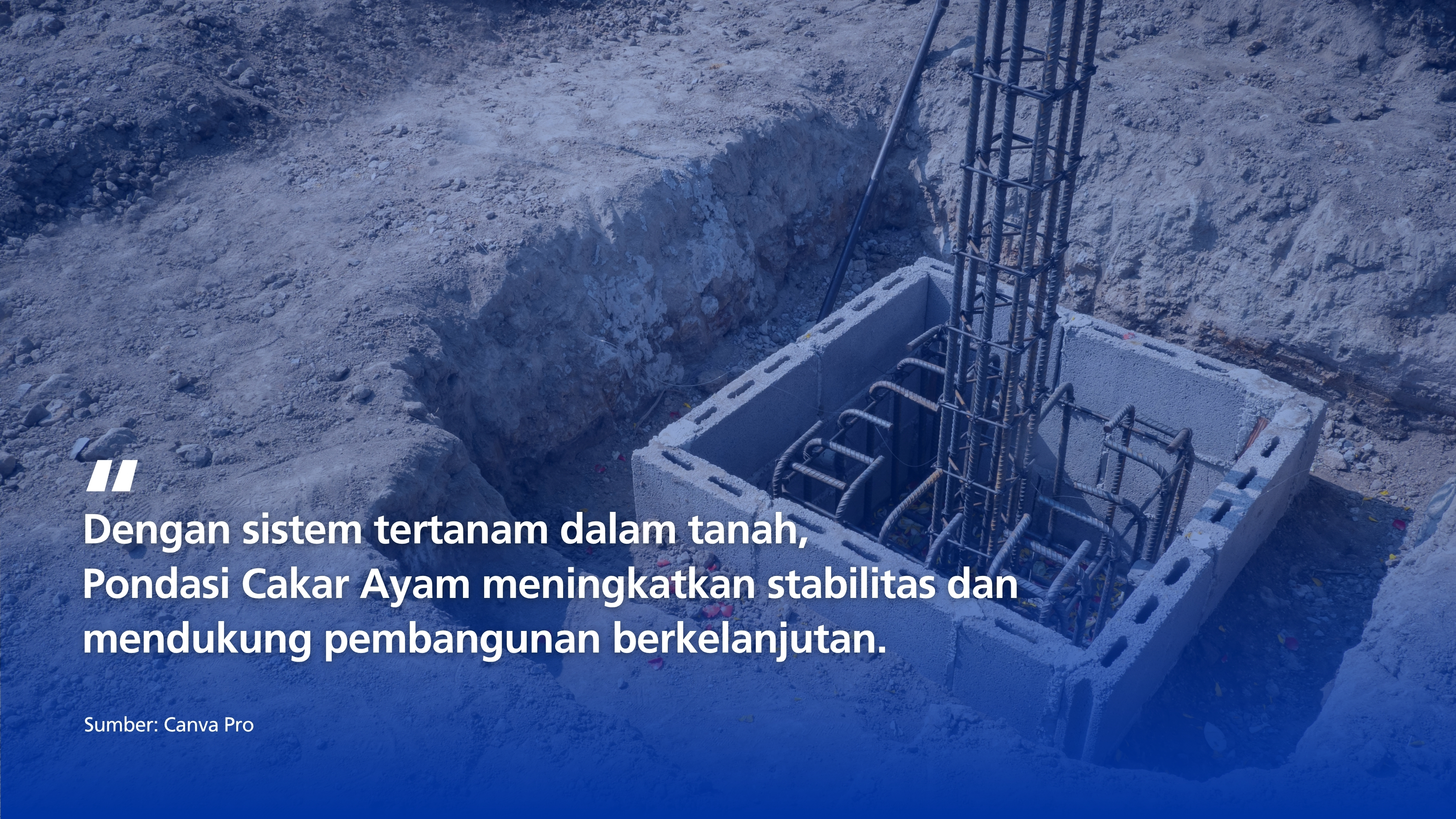
Amid the growing demand for infrastructure that is safe, durable, and environmentally sustainable, the construction industry continues to introduce various innovations. One of Indonesia’s most remarkable engineering innovations that remains widely recognized for its effectiveness is the Chicken Claw Foundation System (Cakar Ayam Foundation). This method provides a practical solution for construction on soils with low bearing capacity while supporting the development of stronger and longer lasting structures.
But what exactly is the Chicken Claw Foundation System? Let’s take a closer look, UNDIRA Friends.
As its name suggests, a chicken’s claws are capable of gripping the ground firmly to support its body weight. This natural principle inspired the development of the Chicken Claw Foundation System. Through a specially designed foundation structure, a building can effectively “grip” the soil beneath it, allowing it to withstand loads more stably, even under unfavorable ground conditions.
The Chicken Claw Foundation System was first developed in 1961 by Prof. Dr. Ir. R. M. Sedyatmo, an Indonesian civil engineer who sought a solution for infrastructure development on soft soils. At the time, Indonesia required a foundation technology capable of addressing the challenges posed by diverse geological conditions without the need for extensive ground improvement works.
From this necessity emerged the Chicken Claw Foundation System, which later became one of Indonesia’s most renowned innovations in civil engineering.
The uniqueness of this method lies in the combination of a reinforced concrete slab and cylindrical concrete pipes installed vertically beneath it. These components work together as a unified system to distribute structural loads evenly to the underlying soil.
Before construction begins, engineers conduct a thorough site investigation through various geotechnical tests, including the Standard Penetration Test (SPT). The results of these investigations are used to determine soil characteristics and identify the most appropriate foundation design.
Following the investigation, the locations for the cylindrical concrete pipes are determined. These pipes are installed vertically and connected to the concrete slab above. Once all components are in place, concrete casting is carried out to create a strong and integrated foundation system.
Through this mechanism, building loads are not concentrated at a single point but are distributed across a much wider area. This is what gives the Chicken Claw Foundation System its exceptional stability, particularly on soft soils or soils with low bearing capacity.
One of the reasons this method continues to be widely utilized is its ability to enhance the service life of structures. A stable foundation can significantly reduce the risk of soil settlement, structural damage, and recurring maintenance requirements in the future.
Furthermore, the more uniform load distribution makes structures more resistant to environmental influences, including vibrations and certain dynamic loads. With a longer service life and lower maintenance demands, the Chicken Claw Foundation System supports the principles of sustainable construction and development.
The advantages of this method have been demonstrated through numerous strategic infrastructure projects throughout Indonesia. One of the most notable examples is the runway construction at Soekarno-Hatta International Airport. Since much of the airport is located on soft soil, a foundation system capable of providing long term stability was essential.
The successful implementation of the Chicken Claw Foundation System in this project paved the way for its application in various other developments, including highways, bridges, industrial areas, and large scale buildings.
The Chicken Claw Foundation System illustrates that civil engineering innovation is not solely about structural strength but also about safety, efficiency, and sustainability. This innovation stands as proof that Indonesian ingenuity can provide practical solutions to the nation’s infrastructure challenges.
For UNDIRA Friends who are interested in exploring the fields of construction, geotechnics, structural engineering, and modern infrastructure technology, the Civil Engineering Study Program at Universitas Dian Nusantara (UNDIRA) offers a learning environment that integrates theoretical knowledge, field practice, research activities, and contemporary case studies. Through this approach, students not only gain a solid understanding of civil engineering concepts but also develop the ability to create innovative solutions that contribute to society and national development.
Source of References:
Cakar Ayam Bangunan: Fungsi, Kelebihan dan Cara Instalasi
Pondasi Cakar Ayam: Fungsi, Cara Menghitung dan Memasangnya!
Mengenal Pondasi Cakar Ayam, Teknik Konstruksi Asli Indonesia
Press Contact :
Biro Humas & Sekretariat Universitas Dian Nusantara
Facebook : www.facebook.com/undiraofficial
Instagram : www.instagram.com/undiraofficial
Twitter : www.twitter.com/undiraofficial
www.undira.ac.id


.jpg)

Campus Tanjung Duren
Jln. Tanjung Duren Barat II No. 1
Grogol, Jakarta Barat. 11470
Campus Green Ville
JIn. Mangga XIV No. 3
Campus Kranggan
Jln. Raya Kranggan, No.6,
Jatiraden, Kec. Jatisampurna, Bekasi. 17432


