

Article

Often Misunderstood: Are All Radiation Dangerous? Read the Explanation Below


 By :
By : 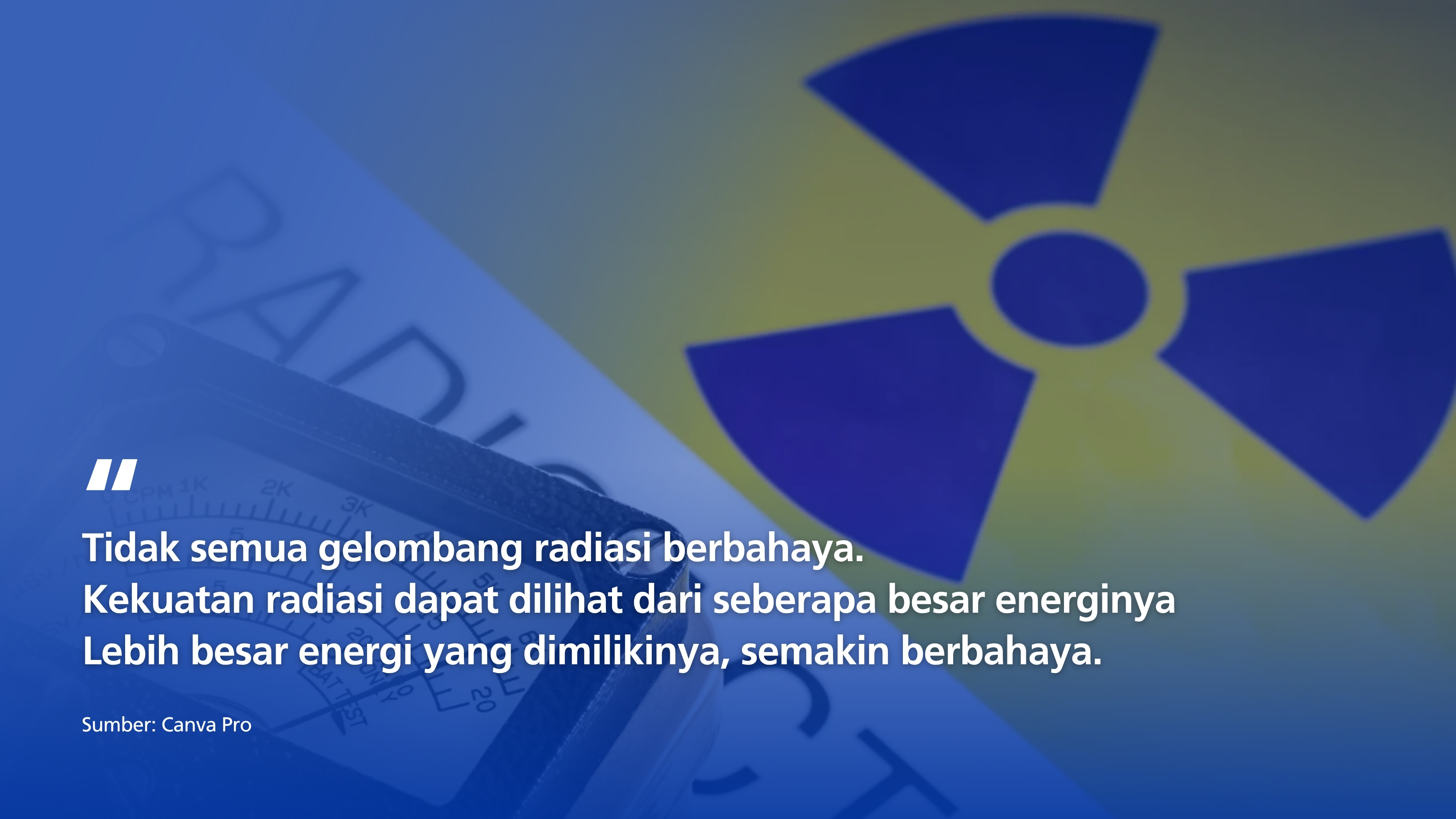
Sometimes, when we fall asleep with devices near our bodies, our loved ones will naturally advise us to move them away, especially from the area around our heads. Why is that? Well, it is not without reason, UNDIRA friends. It has to do with radiation.
In our daily lives, we recognize that radiation can be emitted by various devices around us, such as smartphones, TVs, microwaves, Wi-Fi routers, sunlight, and even bananas. Let's take a simple example: when you turn on a light, the fixture is actually radiating electromagnetic waves throughout the room.
This happens because when electricity flows through a lamp, energy waves are emitted via light particles (photons). This is where electromagnetic radiation is generated.
Despite its abundance around us, radiation is often viewed solely in a negative light. It is notorious for its perceived threats and its potential to cause adverse effects, such as genetic mutations. Other narratives also highlight its destructive impacts, as seen in the case studies of the Fukushima and Chernobyl reactors. However, in reality, these perceptions and narratives do not justify a blanket negative view of all radiation.
Fundamentally, radiation is energy or specific particles emitted or released by an object in the form of waves, which can travel from one space to another. However, not all radiation waves share the same intensity.
Based on their energy levels, radiation can be classified into two categories: ionizing (gamma rays, beta particles, X-rays, and alpha particles) and non-ionizing (visible light, microwaves, and radio waves), depending on the amount of energy they carry.
Ionizing radiation tends to be more dangerous because the large amount of energy it carries does not dissipate easily; it can directly strike atoms in our bodies, potentially damaging tissues and cellular DNA (Deoxyribonucleic Acid).
Furthermore, our bodies also play a role in determining our resistance to radiation. The energy transmitted by radiation does not simply vanish; it gradually accumulates in the body over time. Consequently, side effects such as dizziness, sleep disturbances, and other discomforts can occur in some individuals. The presence of antioxidants is also believed to help manage the excessive radiation entering our bodies.
Understanding radiation comprehensively is not merely general knowledge; it is a crucial foundation in the ever-evolving field of electrical engineering. Every electronic device designed, every communication system built, and every wireless infrastructure developed carries a profound responsibility for user safety.
Therefore, in-depth research into radiation safety studies is a core pillar that cannot be ignored in modern electrical engineering practices. For those of you interested in delving into how engineers design systems that are safe from electromagnetic wave exposure, or how international standards like IEEE and ICNIRP are applied in technological development, the Electrical Engineering Study Program at Universitas Dian Nusantara (UNDIRA) opens its doors wide for you to explore this field further.
Ultimately, the best engineers are not just those capable of creating advanced technology, but also those who ensure that both technology and radiation literacy are factually accessible to society.
Source of References:
https://www.ruangguru.com/blog/konsep-gelombang-elektromagnetik
Setiap hari kita dikelilingi radiasi - Material Populer, Youtube
Press Contact :
Biro Humas & Sekretariat Universitas Dian Nusantara
Facebook : www.facebook.com/undiraofficial
Instagram : www.instagram.com/undiraofficial
Twitter : www.twitter.com/undiraofficial
www.undira.ac.id




Campus Tanjung Duren
Jln. Tanjung Duren Barat II No. 1
Grogol, Jakarta Barat. 11470
Campus Green Ville
JIn. Mangga XIV No. 3
Campus Kranggan
Jln. Raya Kranggan, No.6,
Jatiraden, Kec. Jatisampurna, Bekasi. 17432


