

Article

Material Study 101: Magnesium’s Characteristics and the Challenges of Using It in Industry


 By :
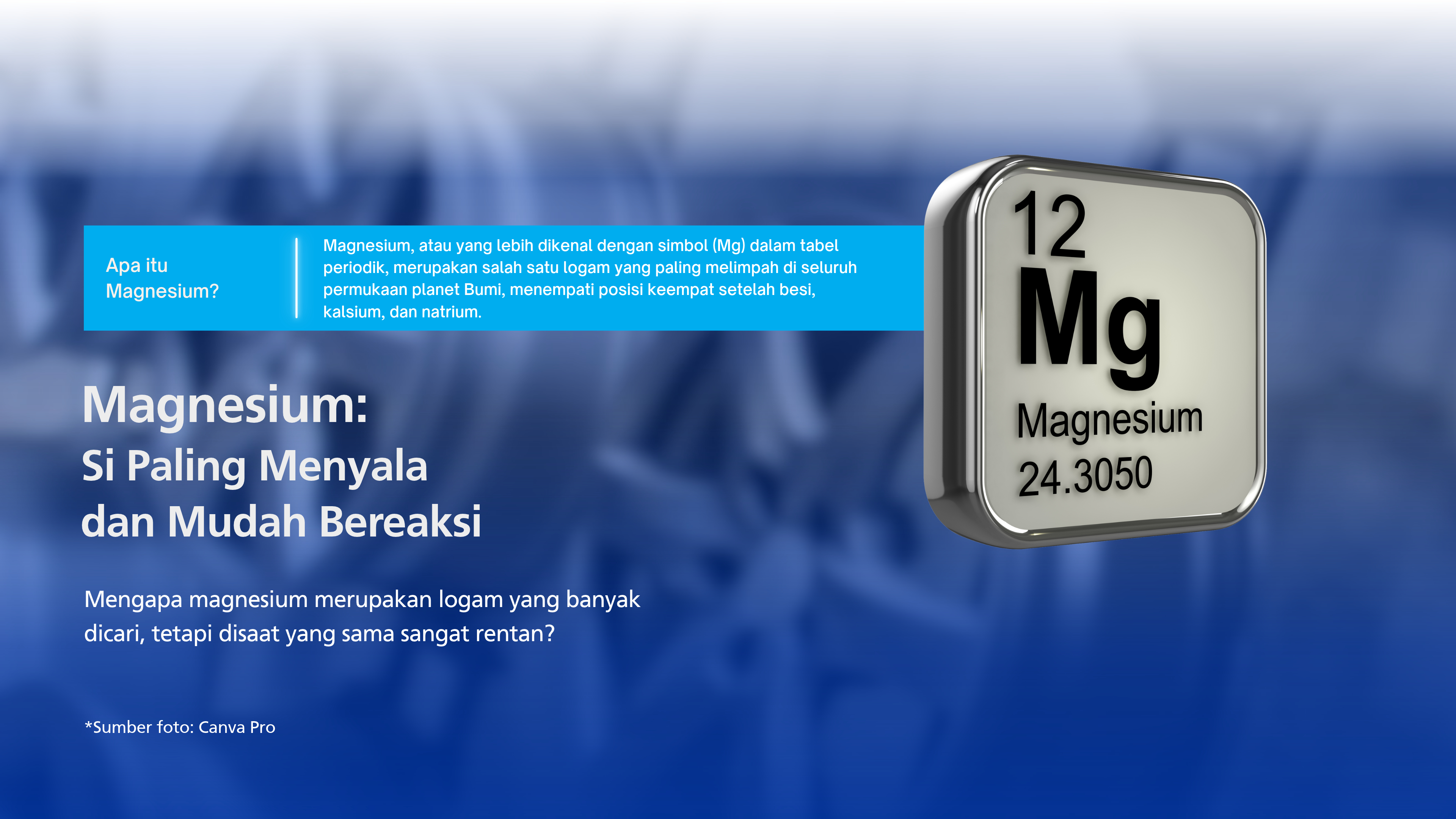
Magnesium, better known by its symbol Mg on the periodic table, is one of the most abundant metals on Earth, ranking fourth after iron, calcium, and sodium. Interestingly, magnesium isn’t found in pure form in nature. Instead, it’s bound to other metallic elements, as in magnesite (MgCO₃) and dolomite (CaMg(CO₃)₂).
According to geological surveys, magnesium makes up 2.4% of the Earth’s crust. The history of this metal goes back to 1755, when Scottish chemist Joseph Black first identified it. Magnesium’s popularity kept growing, and by the late 19th century, Carl Griesheim had begun studying its characteristics in depth. The metal was eventually produced at scale during World War I and World War II, going into everything from military equipment to components for combat vehicles.
So what makes magnesium so special in manufacturing and industry? Let’s get into it, starting with a few basics. First, magnesium is highly reactive. In other words, in liquid, solid, or powder form, it can react with other materials to create new substances, or be used to make alloys. Second, UNDIRA friends, magnesium can react with both metallic and non-metallic elements. That’s because its electron configuration lets it give up electrons easily and settle into a stable state. For example, magnesium can react with oxygen (a non-metal) to form magnesium oxide, which is often used in making fertilizer and glass.
In manufacturing and industry, magnesium is known as one of the lightest metals in the world (lithium is lighter still). That comes down to its density, which is only 1.74 g/cm³, or 1,740 kg/m³. Magnesium also conducts heat fairly well, though not as well as copper or aluminum. That’s why it’s often used in vehicle and machine components. Besides carrying heat well, it makes vehicles lighter, which in turn can boost fuel efficiency.
Structurally, magnesium is also good at absorbing and dampening vibrations. This ability comes from the fairly dense arrangement of its atoms, which form a hexagonal close-packed (HCP) structure. As a result, magnesium (especially pure magnesium) has a damping capacity of 0.03–0.1 GPa (gigapascals), which is considered very good compared with other metals on the Hugoniot Elastic Limit (HEL) scale.
Okay, so by now it’s clear why magnesium is so sought after and so widely used across industry and research. But like any other material, it has its weaknesses too. First, according to findings from Indonesia’s National Research and Innovation Agency (BRIN), magnesium is naturally prone to corrosion from most acids and bases, unless it has a protective coating or has been through anodizing. Second, magnesium in liquid or powder form is highly flammable when it reacts with oxygen and water. That’s because magnesium can “steal” oxygen from water to form magnesium oxide (MgO) and hydrogen (H), both of which can set off chain reactions and even explosions. For this reason, most manufacturers have special procedures in place for handling magnesium. Finally, that same dense atomic structure also makes magnesium relatively brittle.
Every material has its upsides and downsides. Although magnesium is plentiful and has many potential uses, handling it takes a great deal of caution. For UNDIRA friends who’d like to learn more about manufacturing processes and get in-depth explanations of other materials, the Mechanical Engineering Study Program at Universitas Dian Nusantara (UNDIRA) is the right choice. UNDIRA has a well-equipped physics laboratory, and its lecturers are highly qualified in their fields, so you can uncover the secrets of materials as deeply as you want.
Sources of Referencei:
Amiscientific - Karakteristik Magnesium
Yijin Solutions - What is Magnesium | Properties & Applications in CNC Machining
Pans CNC - Sejarah Magnesium dan Perkembangannya
(Danang Respati Wicaksono / Humas UNDIRA)
Press Contact :
Biro Humas & Sekretariat Universitas Dian Nusantara
Facebook : www.facebook.com/undiraofficial
Instagram : www.instagram.com/undiraofficial
Twitter : www.twitter.com/undiraofficial
www.undira.ac.id
Other

Educate Generations, and Building the Nation: Reflection and Hope for the Future of the Country
Read more
UNDIRA Successfully Holds Seminar and Workshop on Sustainable Business Innovation for Students
Read more
Improving Quality Assurance: PPMI UNDIRA Conducts External Benchmarking with Telkom University’s Quality Assurance Unit
Read more
Campus Tanjung Duren
Jln. Tanjung Duren Barat II No. 1
Grogol, Jakarta Barat. 11470
Campus Green Ville
JIn. Mangga XIV No. 3
Campus Kranggan
Jln. Raya Kranggan, No.6,
Jatiraden, Kec. Jatisampurna, Bekasi. 17432


