

Article

Material Study 101: Titanium, the Standout Material and Best Friend of Modern Devices


 By :
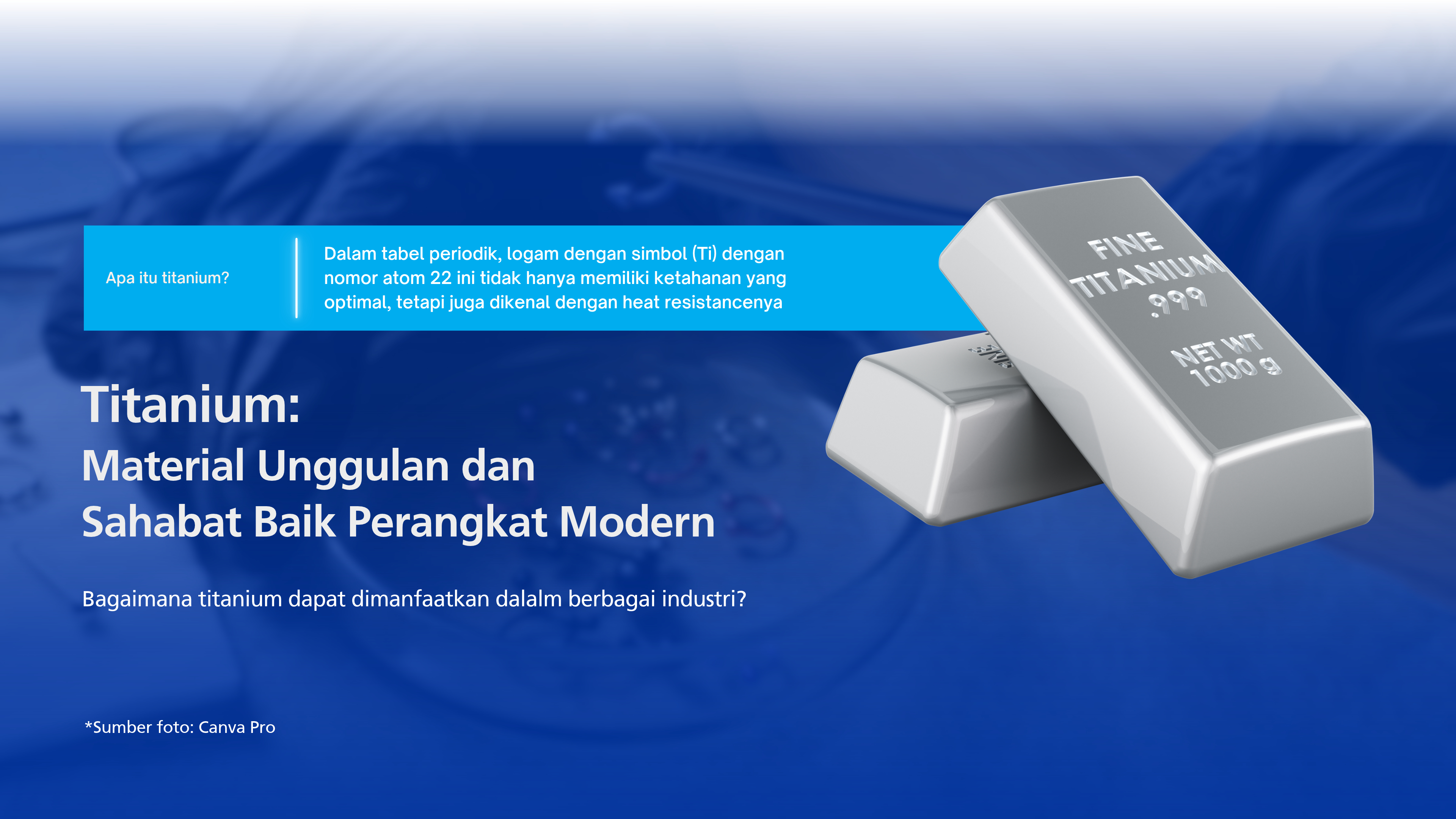
Who hasn’t heard of titanium? Titanium (Ti), the element with atomic number 22, now forms the frames of premium flagship smartphones like the Galaxy S Ultra series and some iPhone models. It also strengthens the airframes of several jets, and it can even go inside the human body as a medical implant. A few questions are probably popping into your head by now. “How come this metal is used so much more than others, like, let’s say, gold, which is worth far more?” Or, “Why is titanium so often touted as a standout material?” In this installment of Material Study 101, let’s dig into what sets this metal apart.
Titanium is generally found in relatively large quantities within the Earth's crust, ranging from mountainous regions to coastal areas. Interestingly, despite its abundance in nature, titanium is rarely found in its pure form, Kawan UNDIRA! Instead, it is commonly found in minerals such as ilmenite (FeTiO₃) and rutile (TiO₂), which occur in rocks and mineral sand deposits.
In the manufacturing industry, titanium is highly regarded for its advantageous combination of mechanical and chemical properties. With a density of approximately 4.51 g/cm³, titanium is considerably lighter than steel, which has a density of around 7.85 g/cm³. Its main advantages lie in its high specific strength, excellent corrosion resistance, and ability to form a stable protective oxide layer on its surface.
So what makes titanium one of those standout materials? First, it has a very stable surface (an oxide layer) that lets it resist corrosion from the environment, acids, bases, and other metals (as long as those metals rank equal to or higher than it on the nobility scale, though anodizing can get around this weakness). Besides its stable outer layer, titanium also stands up well to high temperatures, far above gold and most other metals, which helps it keep its structure intact. Its melting point is 1,668°C, just one spot below tungsten (whose melting point of 3,422°C is the highest of any metal).
Titanium’s sturdiness also owes something to its elastic modulus (stiffness), which is lower than steel’s: roughly 110–115 GPa (gigapascals), compared with about 200 GPa for steel. In practice, that means titanium can bend further and still spring back to its original shape before it deforms permanently. It’s why titanium parts don’t dent or break easily, and why they stand up to repeated loading, the kind of stress behind material fatigue.
The final reason titanium is regarded as a standout material is that it’s biocompatible with organic matter, like human organs. Wait, how is that possible? After all, some people can’t even wear gold jewelry without itching! The secret lies in its oxide layer. That layer of TiO2 guards against corrosion, and it also keeps many ions from breaking loose. (For context, it’s those loose ions that interfere with how the body’s cells work, and the cells see them as a threat.) That’s also why titanium can be used in medical implants.
Titanium has its downsides too, UNDIRA friends. Even though it’s corrosion-resistant thanks to its natural oxide layer, it doesn’t get along well with metals that corrode more easily, like iron or zinc. This is known as galvanic corrosion. In manufacturing, it’s also a bit “finicky”: it’s hard to cut, and it isn’t great at conducting heat or electricity. Finally, for all its durability, titanium can’t match the scratch resistance of ceramic, pure sapphire, or tungsten when measured on the Mohs scale. No wonder high-end smartphone makers like Samsung and Apple have started cutting back on titanium.
A standout material isn’t about which one is the priciest or the shiniest. It’s about which one is best suited to the job. Titanium strikes a rare balance between being lightweight, strong, corrosion-resistant, and kind to the body, though it comes with a “price”: a complicated production process and high costs. For UNDIRA friends interested in mechanical studies and complex manufacturing, the Mechanical Engineering Study Program at Universitas Dian Nusantara (UNDIRA), with its Metallurgy concentration, offers hands-on learning through its physics laboratory, along with experts who know their field well. Come join us, and become the best engineer ever!
Sources of Reference:
Galore Metal - Apakah batang titanium kompatibel dengan logam lain?
Gramedia Blog - Titanium dengan Kekuatan dan Kelebihannya, Dipakai di Mana Saja?
It's a Material World Broadcast - YouTube - Why is Titanium Biocompatible? | Ep. 3 | It's a Material World Podcast
Rekayasa Terperinci - YouTube - Apa Itu Titanium? Logam Terkuat di Dunia dan Beragam Penggunaannya di Industri
Halodoc - Bahan Titanium: Logam Ringan, Kuat, Antikarat, Aman Tubuh
(Danang Respati Wicaksono / Humas UNDIRA)
Press Contact :
Biro Humas & Sekretariat Universitas Dian Nusantara
Facebook : www.facebook.com/undiraofficial
Instagram : www.instagram.com/undiraofficial
Twitter : www.twitter.com/undiraofficial
www.undira.ac.id
Other

Opening Business Opportunities for Local MSME Entrepreneurs: UNDIRA and DISDAGIN Bandung Emphasize Export Efforts
Read more
Committed to Enhancing Gen Z’s Academic Writing Competence: FBIS UNDIRA Holds International Guest Lecture with Universiti Malaysia Terengganu and Universiti Malaya
Read more
Great Transportation, Indonesia Moves Forward! Comfortable, Efficient, and Affordable on National Transport Day
Read more
Campus Tanjung Duren
Jln. Tanjung Duren Barat II No. 1
Grogol, Jakarta Barat. 11470
Campus Green Ville
JIn. Mangga XIV No. 3
Campus Kranggan
Jln. Raya Kranggan, No.6,
Jatiraden, Kec. Jatisampurna, Bekasi. 17432


