

Article

Database Management in the Digital Era: Understanding SQL and NoSQL, and the Differences Between Them


 By :
By : 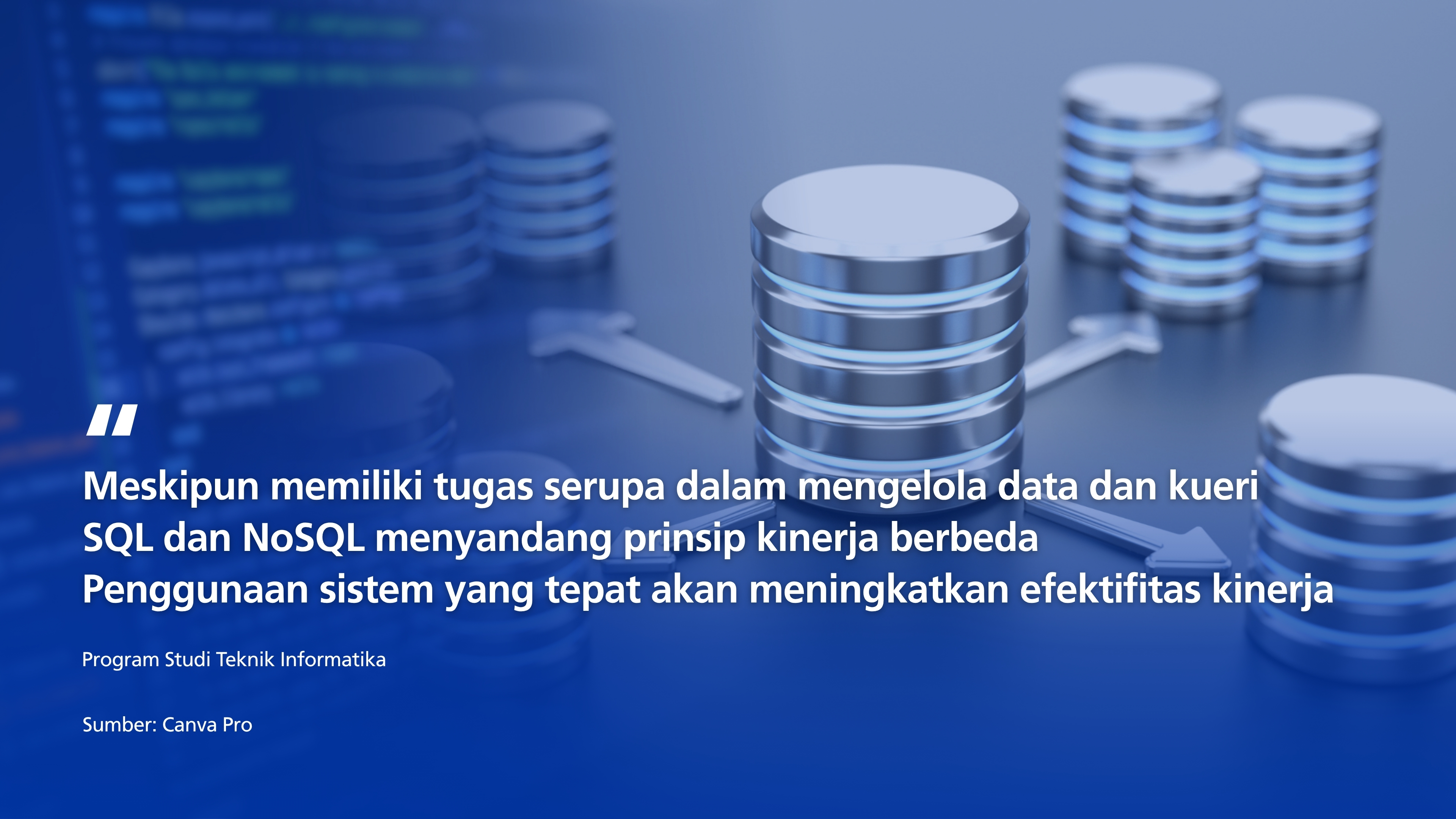
As data continues to be generated and utilized on an unprecedented scale, human civilization has entered what is often called a data-driven civilization. Once regarded primarily as an administrative resource, data has evolved into a strategic asset that helps guide operations, reduce subjective bias in decision-making, and maintain organizational integrity.
This raises an important question: how can massive amounts of data be managed and accessed quickly, consistently, and securely? The answer lies in database systems, with SQL and NoSQL among the two most widely used approaches across industries.
SQL, or Structured Query Language, is closely associated with relational databases that organize data into structured, interconnected tables under a predefined schema. One of its key strengths is the ACID principle (Atomicity, Consistency, Isolation, and Durability), which ensures reliable transactions and consistent data. For example, academic systems can link students, courses, lecturers, and grades through relational tables, while mobile banking relies on the same principles to ensure that transactions are recorded accurately without unintended duplication.
However, relational databases can become more challenging to scale when handling massive data volumes and rapidly increasing workloads. Their structured schemas, complex table relationships, and strict consistency requirements may also introduce additional processing overhead, particularly for applications involving large-scale transactions and queries. Also note that in some cases of data processing, the JavaScript Object Notation, or JSON, may overload the data processing segment; this phenomenon is better known as Parsing Overhead.
NoSQL, meanwhile, emerged to address the growing need to manage dynamic, diverse, and high-volume data. Supporting models such as document, key-value, column-family, and graph databases, NoSQL offers greater flexibility because records do not necessarily have to follow a rigid relational schema. This makes it suitable for various Big Data applications and rapidly evolving systems.
Another major advantage of NoSQL is horizontal scalability. Rather than primarily increasing the capacity of a single server, workloads can be distributed across multiple servers, making NoSQL well suited to applications experiencing sudden increases in traffic and data volume.
This flexibility, however, comes with trade-offs. NoSQL does not inherently provide the same relational capabilities as SQL, particularly for complex relationships and joins between datasets. In systems that follow the BASE principles (Basically Available, Soft State, Eventual Consistency), availability and scalability may be prioritized over immediate consistency, meaning data across replicas may take time to fully synchronize.
Understanding SQL and NoSQL is only the beginning. Designing, building, and managing these systems effectively requires relevant knowledge, guidance, and a supportive learning environment. Through its Software Engineering concentration, the Informatics Engineering Study Program at Universitas Dian Nusantara (UNDIRA) provides a curriculum aligned with industry needs.
At UNDIRA, students of UNDIRA can learn database and application development from the bottom up, from designing database structures to developing large-scale applications, while upholding the values of integrity and professionalism.
Sources of Reference:
Data analytics statistics 2026 - Market insights and industry trends - Folio3
SQL vs NoSQL: Perbedaan, Kelebihan, dan Kapan Menggunakannya
(Danang Respati Wicaksono / Humas UNDIRA)
Press Contact :
Biro Humas & Sekretariat Universitas Dian Nusantara
Facebook : www.facebook.com/undiraofficial
Instagram : www.instagram.com/undiraofficial
Twitter : www.twitter.com/undiraofficial
www.undira.ac.id


Campus Tanjung Duren
Jln. Tanjung Duren Barat II No. 1
Grogol, Jakarta Barat. 11470
Campus Green Ville
JIn. Mangga XIV No. 3
Campus Kranggan
Jln. Raya Kranggan, No.6,
Jatiraden, Kec. Jatisampurna, Bekasi. 17432


